
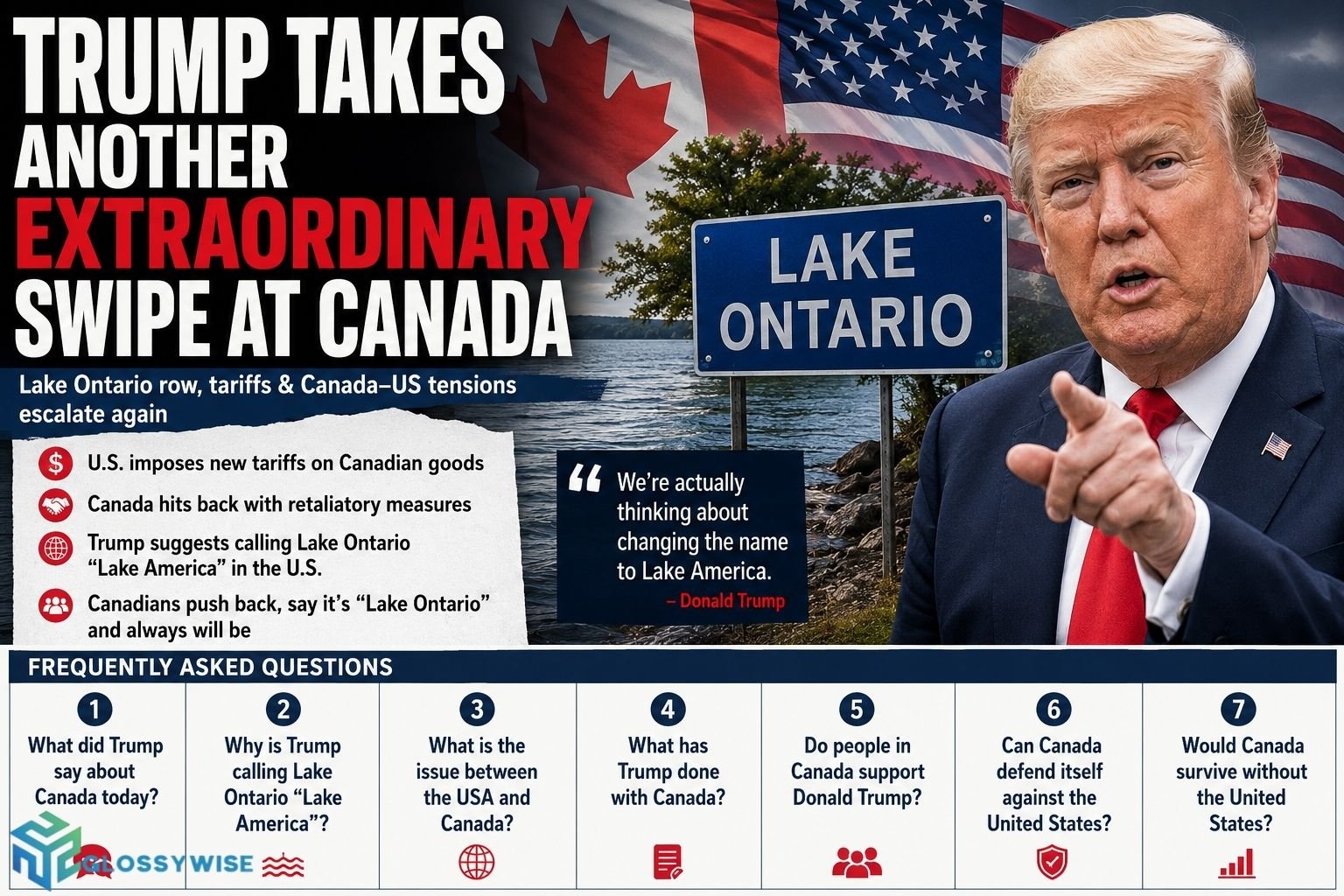
Donald Trump has taken another extraordinary swipe at Canada as tensions between the United States and its northern neighbour continue to rise. The latest dispute is not limited to tariffs and trade negotiations. It has now spilled into a highly symbolic argument over the name of one of North America’s most famous bodies of water, Lake Ontario. Trump has moved to refer to Lake Ontario as “Lake America” in the United States, adding another controversial chapter to an already tense relationship between Washington and Ottawa. The move comes as the two countries remain locked in a trade dispute involving tariffs, retaliation and disagreements over the future of their economic relationship. The controversy has attracted attention because Lake Ontario sits on the border between the Canadian province of Ontario and the United States. While the U.S. president can direct federal agencies in the United States on how they refer to geographical features, that does not automatically change the name used by Canada or international organizations. For Canadians, the latest move is being viewed as another example of Trump’s increasingly confrontational approach toward Canada. Ontario Premier Doug Ford has responded by making it clear that Canada will continue calling the body of water Lake Ontario. A huge Lake Ontario sign was recently unveiled beside the lake, reinforcing Canada’s position.
What Did Trump Say About Canada Today?
Trump’s latest comments about Canada come against the backdrop of a rapidly deteriorating trade relationship. In recent days, he has repeatedly criticized Canada over tariffs, negotiations and what he describes as unfair treatment of American businesses and farmers.
Trump has argued that Canada has benefited from access to the United States while imposing tariffs on American products. Earlier in the current dispute, he described Canada as one of the most difficult countries for the United States to deal with and accused it of taking advantage of America.
One of his most striking recent comments was the suggestion that Lake Ontario could be renamed “Lake America.” Trump said the United States was giving serious consideration to changing the name, connecting the proposal directly to the deteriorating trade relationship with Ontario and Canada.
The comments should be understood in the wider context of Trump’s repeated criticism of Canada. The U.S. president has also previously talked about Canada becoming the 51st U.S. state, a proposal strongly rejected by Canadian leaders.
What Did Donald Trump Say About Canada?
Donald Trump’s criticism of Canada has focused heavily on trade and the country’s relationship with the United States. He has argued that American farmers and businesses have faced unfair treatment from Canadian tariffs and that the United States should no longer accept what he considers an unbalanced relationship.
The current dispute intensified after U.S.-Canada trade negotiations broke down. Trump subsequently imposed additional tariffs on certain Canadian products, while Canada announced retaliatory measures.
Trump has also used increasingly provocative language about Canada’s political status. In one widely reported statement, he argued that Canada wants the benefits of being a U.S. state without actually being one.
Canadian Prime Minister Mark Carney has taken a very different position. His government has rejected Trump’s demands when they believe those demands would undermine Canada’s economic interests or sovereignty. Carney has emphasized that Canada will protect its national interests while responding to U.S. tariffs.
Why Is Trump Calling Lake Ontario “Lake America”?
The Lake Ontario controversy is part of a broader pattern in Trump’s approach to Canada and geographic naming.
Trump has already pushed for changes to the names used by the U.S. government for other geographic locations. His administration previously adopted “Gulf of America” for what was traditionally known as the Gulf of Mexico in U.S. federal usage.
In the case of Lake Ontario, Trump linked the proposed name change to the changing economic relationship with Canada. The lake is particularly symbolic because it directly borders Ontario and the United States.
However, an important distinction is that a U.S. federal naming decision does not mean Canada is required to adopt the new name. Canada’s government, provinces and institutions can continue using the name Lake Ontario. The same applies internationally.
What Has Trump Done With Canada?
Trump’s relationship with Canada has changed dramatically from the traditional image of two close North American allies.
His administration has introduced tariffs affecting Canadian goods, increased pressure during trade negotiations, and repeatedly criticized Canada’s trade policies. The latest escalation has included tariffs of up to 50% on selected Canadian products, while Ottawa has prepared retaliatory measures of its own.
The dispute has also become personal and political. Trump has repeatedly questioned Canada’s treatment of the United States and has spoken about the possibility of Canada becoming an American state.
Canadian leaders have rejected that idea. Prime Minister Mark Carney has instead emphasized Canadian sovereignty and the need for Canada to strengthen its economic and strategic independence.
The result is a relationship that remains deeply interconnected economically but is experiencing an unusually high level of political tension.
What Percent of Canada Likes Trump?
Recent polling suggests that Trump is very unpopular in Canada.
An August 2026 Angus Reid Institute survey found that 79% of Canadians had an unfavourable view of Donald Trump, including 69% who described their view as very unfavourable.
That does not mean every Canadian opposes Trump or everything his administration does. Political opinions differ across Canada, and some Canadians support particular Trump policies or positions. However, the national picture shows that his personal popularity in Canada is extremely low.
The same polling also found an interesting distinction between Canadians’ views of Trump and their views of Americans generally. While 79% viewed Trump unfavourably, 45% still had a favourable view of the American people.
This suggests that many Canadians distinguish between the U.S. population and the political decisions coming from Washington.
Why Is Canada Struggling Right Now?
Canada is facing several economic and social challenges, and the dispute with the United States has added another layer of uncertainty.
The economy, jobs, affordability, housing and healthcare are among the biggest issues Canadians are currently concerned about. Research Co.’s August 2026 polling found that the economy and jobs were the most important issue for 25% of Canadians, followed by housing, homelessness and poverty at 23%, healthcare at 14%, Canada-U.S. relations at 12%, and immigration at 9%.
Another Canadian survey conducted earlier in the summer found that the rising cost of living was the country’s leading concern, followed by the economy, healthcare and housing affordability.
The U.S. trade conflict can make these problems more complicated because Canada and the United States have deeply connected supply chains. Tariffs can increase costs for companies, disrupt trade and potentially affect consumers.
Canada is therefore trying to balance several goals at once: protecting domestic industries, maintaining access to the American market, diversifying international trade and keeping prices manageable for Canadian households.
What Are Canada’s Biggest Issues?
Canada’s biggest domestic issues in 2026 include the cost of living, economic growth, housing affordability, healthcare, immigration and employment.
The cost of living remains particularly important because Canadians are concerned about the price of everyday necessities and household expenses. Housing is another major issue, especially in expensive urban markets where purchasing a home can be difficult for younger Canadians.
Healthcare is also a major concern because Canadians rely heavily on the public healthcare system and many communities face challenges involving access, waiting times and staffing.
Canada-U.S. relations have become an increasingly important issue as well. The latest polling from Research Co. placed Canada-U.S. relations among the country’s leading concerns, while other polling has shown that Trump and his administration have become much more prominent in Canadian political discussions.
Immigration and public safety also remain part of the national debate.
In other words, Canada’s problems cannot be reduced to the Trump dispute. The country is dealing with a combination of economic, housing, healthcare and geopolitical pressures.
Can Canada Defend Itself Against the US?
Canada has its own military and significant defence capabilities, but a hypothetical military conflict between Canada and the United States would be an extraordinarily unequal scenario.
Canada is a NATO member and has traditionally relied heavily on cooperation with the United States and other allies for continental and collective defence. At the same time, Canada has been increasing defence spending and investing in new capabilities.
In March 2026, Prime Minister Mark Carney’s government announced that Canada had reached NATO’s 2% defence-spending target and said the country was moving toward the Alliance’s newer long-term defence investment requirements.
Canada is also focusing more heavily on Arctic security, military infrastructure and partnerships with NATO allies.
So while Canada has a capable armed force and strong alliances, it would not be realistic to describe Canada and the United States as militarily equal countries. Canada’s strongest defence advantage would come from its geography, alliances, military partnerships and the enormous political and economic consequences that would accompany any conflict.
More importantly, Canada and the United States remain NATO allies. NATO’s Article 5 framework is based on collective defence among members, making an armed conflict between two NATO allies an extremely different scenario from a conventional war between unrelated states.
Would Canada Survive Without the United States?
Canada could continue to exist as an independent country without the United States, but separating the two economies would be extremely difficult.
The United States is Canada’s largest trading partner, and the two countries have deeply integrated manufacturing, energy, agricultural and transportation networks. Businesses on both sides of the border depend on this relationship.
That does not mean Canada has no alternatives.
Canada can expand trade with Europe, Asia and other international markets, strengthen domestic production and develop new supply chains. The current dispute is already encouraging Canadian policymakers and businesses to think more seriously about reducing dependence on the U.S. market.
However, replacing such a massive and geographically convenient trading relationship would take years rather than months.
This is why the current tariff dispute is so important. The question is not simply whether Canada can trade without America; it is how expensive and disruptive it would be to substantially reduce that dependence.
What Is the Issue Between the USA and Canada?
The current issue between the United States and Canada is primarily about trade, tariffs, economic policy, and the broader political relationship between the two countries.
The latest trade negotiations broke down after both sides disagreed over terms. Canada said some U.S. demands were uneconomic and unacceptable, while the Trump administration blamed Canada for failing to reach an agreement.
The United States subsequently imposed tariffs on selected Canadian goods, and Canada announced retaliatory tariffs.
But the dispute goes beyond tariffs.
Trump has repeatedly criticized Canada and has questioned the traditional nature of the bilateral relationship. His comments about Canada becoming a U.S. state have particularly angered Canadian officials and the public.
The Lake Ontario naming dispute adds a symbolic dimension to the conflict. What began primarily as a trade disagreement has increasingly become a debate about national identity, sovereignty and how each country sees the other.
What Percent of the Country Likes Donald Trump?
If the question refers to Canada, recent polling indicates that only a minority of Canadians hold a favourable view of Trump.
The most recent Angus Reid data cited above found that 79% of Canadians had an unfavourable view of Trump, meaning approximately one in five Canadians held a favourable view.
It is important to remember that polling results can change depending on the date, wording of the question,n and sample used. Therefore, there is no single permanent percentage that represents Canadian support for Trump.
Trump’s popularity is also different in Canada compared with the United States. A separate Angus Reid poll of Americans found that 34% approved of Trump’s performance as president in August 2026, while 58% disapproved.
Do People in Canada Support Trump?
Some Canadians do support Donald Trump, but he is broadly unpopular across the country.
Trump has supporters who agree with his approach to trade, immigration, taxation, energy policy,cy or relations with the United States. However, the national polling picture is strongly negative.
The Angus Reid Institute reported that 79% of Canadians had an unfavourable opinion of Trump in its August 2026 survey.
His repeated comments about Canada becoming a U.S. state, combined with tariff disputes and criticism of Canadian policies, have contributed to the negative perception.
At the same time, Canadians do not necessarily view all Americans negatively. The same Angus Reid research found that 45% of Canadians viewed the American people favourably, while 48% viewed them unfavourably.
That distinction is important because the Canada-U.S. relationship is much larger than the relationship between two individual political leaders.
Why Did Doug Ford Respond to Trump’s Lake Ontario Move?
Ontario Premier Doug Ford responded strongly to Trump’s Lake Ontario proposal.
A large sign reading “Lake Ontario” was unveiled beside the lake, making Canada’s position clear. Ford has said that Ontario will continue to use the traditional name regardless of the U.S. federal government’s decision.
The response is significant because Lake Ontario is shared by Canada and the United States. A U.S. government decision about terminology does not control how Canadian authorities identify the lake.
Ford’s response therefore became both a practical statement and a symbolic political message: Canada does not have to adopt U.S. terminology simply because the White House chooses it.
Is Lake Ontario Actually Being Renamed?
The short answer is no, universally.
Trump’s administration can determine the terminology used by the U.S. federal government, but that does not automatically force Canada, international organizations or private citizens to use the same name.
Lake Ontario remains known as Lake Ontario in Canada. The lake is one of the five Great Lakes and forms part of the international border between Ontario and the United States.
Therefore, readers should be careful with headlines suggesting that the entire lake has officially received a new name everywhere.
The dispute is partly about who controls naming conventions and how geographic names are recognized across international borders.
How Could the Trump-Canada Trade War Affect Ordinary People?
Tariffs can eventually affect ordinary consumers because businesses may face higher costs when imported goods become more expensive.
For Canadian companies that sell products into the United States, tariffs can make those products less competitive. American companies that depend on Canadian raw materials or components can also face higher costs.
The trade relationship is particularly important because the two countries have highly integrated supply chains.
Recent U.S. tariffs have targeted a wide range of Canadian products, while Canada’s planned retaliatory measures have targeted American goods. The categories involved include products such as food, clothing, consumer products and industrial goods.
The longer the dispute continues, the greater the potential for companies to change suppliers, raise prices or delay investment.
What Happens Next Between Trump and Canada?
The next stage of the dispute will depend heavily on whether Washington and Ottawa can return to serious negotiations.
Both countries have strong economic reasons to avoid a permanent breakdown. Businesses benefit from cross-border trade, consumers benefit from integrated supply chains, and industries on both sides depend on access to the neighbouring market.
At the same time, Canadian leaders are increasingly emphasizing economic diversification and national sovereignty, while Trump continues to demand changes that he argues would benefit American workers and businesses.
Canada has also been increasing defence spending and strengthening relationships with other NATO partners as it reassesses its strategic position.
The Lake Ontario controversy may therefore be remembered as one of the most unusual symbols of a much larger dispute.
Frequently Asked Questions
What did Trump say about Canada today?
Donald Trump has once again criticized Canada amid ongoing tensions between the two countries. His latest comments have focused on trade, tariffs and the broader relationship between the United States and Canada.
Why is Trump calling Lake Ontario “Lake America”?
Trump has proposed using the name “Lake America” in U.S. federal usage as part of his broader approach to geographic naming. Canada has rejected the change and continues to refer to the body of water as Lake Ontario.
What is the issue between the USA and Canada?
The main issues include tariffs, trade negotiations, economic policies, and disagreements over the future of Canada-U.S. relations. Trump’s comments about Canada have also created tensions over Canadian sovereignty.
What has Trump done with Canada?
Trump has imposed tariffs on certain Canadian goods, pressured Canada during trade negotiations, and repeatedly criticized Canada’s trade policies. He has also made controversial comments about Canada potentially becoming a U.S. state.
Do people in Canada support Donald Trump?
Some Canadians support Donald Trump, but recent polling indicates that he is broadly unpopular in Canada. His trade policies and comments about Canada have contributed to strong negative opinions among many Canadians.
Can Canada defend itself against the United States?
Canada has its own military and is a NATO member, but the United States has significantly greater military resources. Canada also relies on alliances and international defence partnerships as important parts of its national security strategy.
Would Canada survive without the United States?
Yes, Canada could remain an independent country without the United States, but separating the two economies would be extremely challenging. Canada and the U.S. have deeply connected trade, energy, manufacturing and supply chains, so a major economic separation could take years to manage.
Trump Takes Another Extraordinary Swipe at Canada: Final Takeaway
Donald Trump’s latest swipe at Canada is about much more than a name on a map. The Lake Ontario versus “Lake America” controversy has emerged during one of the most difficult periods in modern Canada-U.S. relations. Trade negotiations have broken down, tariffs have escalated,d and both governments have taken increasingly firm positions. For Canada, the dispute has become a test of economic independence and national sovereignty. For the United States, the Trump administration argues that it is trying to secure better terms for American workers, farmers and businesses. Meanwhile, public opinion in Canada has turned sharply against Trump personally, with recent Angus Reid polling showing 79% of Canadians holding an unfavourable view of him. Whether the current tensions lead to a new trade agreement or a longer period of economic separation remains uncertain. What is clear is that the traditional Canada-U.S. relationship is under significant pressure, and Trump’s latest comments have added another extraordinary chapter to the story.
