
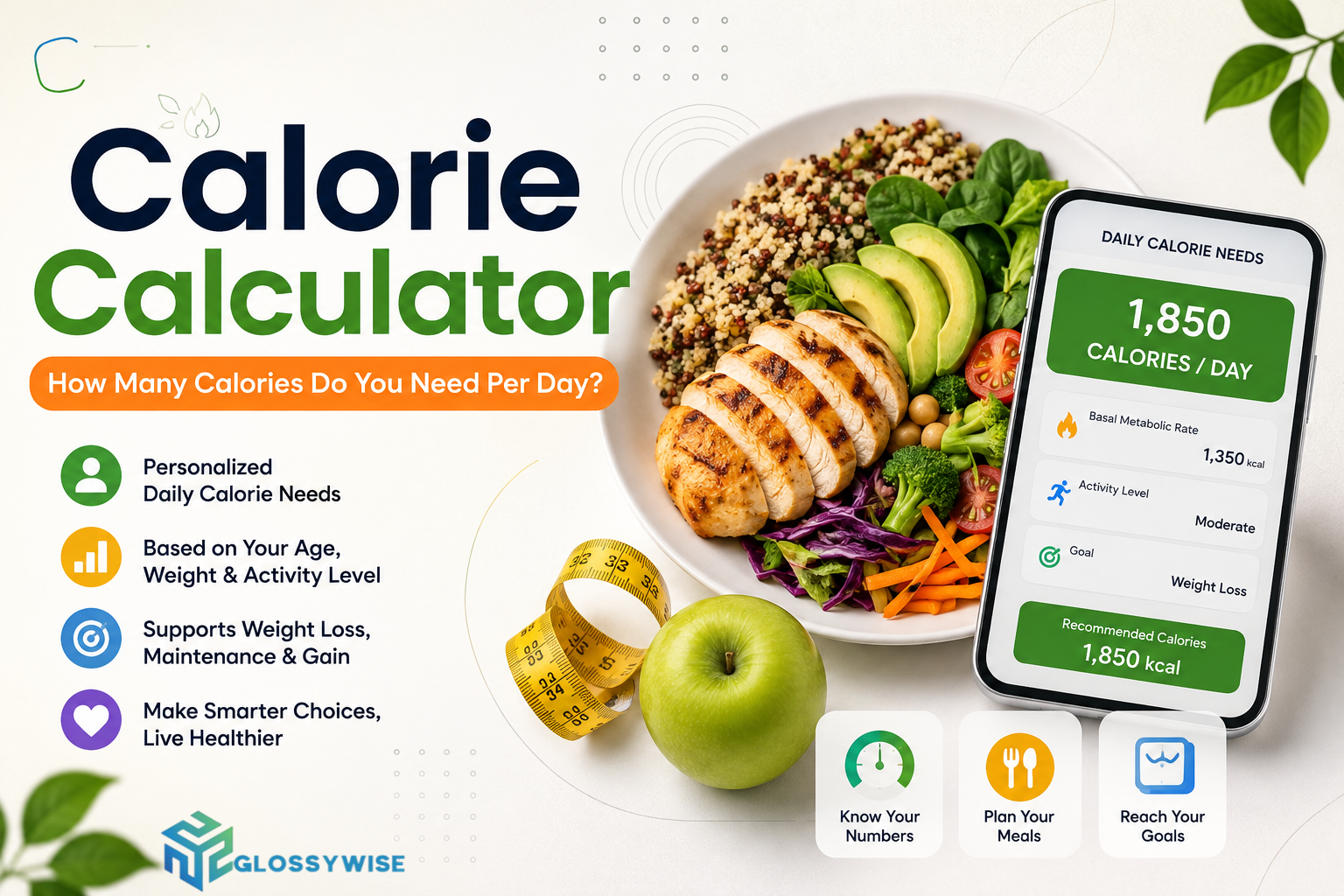
Knowing how many calories you need each day can help you understand your energy requirements, manage your weight, and make more informed food choices. A calorie calculator estimates your daily calorie needs using information such as age, sex, height, weight, and activity level. Your calorie needs are different from those of another person. Even two people with the same age can require different amounts of energy depending on body size, muscle mass, physical activity, and overall lifestyle. Whether your goal is maintaining your current weight, losing weight, or simply understanding your daily calorie requirements, a calorie calculator can give you a useful starting point. This guide explains how calorie needs are estimated, how calorie deficits work, what TDEE means, and how to use calorie calculations safely and effectively.
What Is a Calorie and Why Does It Matter?
A calorie is a unit used to measure energy. The food and drinks you consume provide energy that your body uses for everything from basic biological functions to physical activity. Your body needs energy even when you are resting. Calories support essential processes such as breathing, blood circulation, maintaining body temperature, and normal organ function. You also use additional energy when walking, exercising, working, and completing everyday tasks. When you consistently consume about the same amount of energy that your body uses, your weight may remain relatively stable. If you regularly consume more energy than you use, the excess can contribute to weight gain. If you consume less energy than you use, your body may rely on stored energy, which can contribute to weight loss. However, weight management is more complicated than calories alone. Sleep, medications, hormones, medical conditions, stress, physical activity, and food choices can all influence body weight.
How Many Calories Should You Eat a Day?
There is no universal number of calories that every adult should eat each day. Your daily calorie requirement depends on factors such as age, sex, height, body weight, physical activity, muscle mass, and your personal goal. A calorie calculator estimates your maintenance calories, which are the approximate calories your body needs to maintain its current weight at a particular activity level. For example, someone who spends most of the day sitting may require fewer calories than someone with the same body measurements who exercises frequently or has a physically demanding job. If your goal is weight loss, the appropriate calorie target should provide enough energy and nutrients to support your health while creating an appropriate calorie deficit.
How Many Calories Should I Eat a Day by Age?
Age can influence calorie requirements, but age alone cannot determine how many calories you should consume. As people get older, changes in muscle mass, body composition, activity levels, and metabolism can affect energy requirements. A physically active older adult may need more calories than a younger person with a very sedentary lifestyle. Children and teenagers have different nutritional requirements because their bodies are still developing. Pregnant and breastfeeding individuals also have specific nutritional needs. For this reason, an age-based calorie chart can provide general information, but a personalized calorie estimate is more useful when planning your diet.
How Many Calories Should I Eat a Day by Age to Lose Weight?
Age is one factor in determining calorie requirements, but it should not be used by itself to choose a weight-loss calorie target. A person’s height, current weight, sex, activity level, health status, and normal calorie intake can make a significant difference. Someone who is highly active may need considerably more calories than a person of the same age who has a sedentary lifestyle. The basic principle of weight loss is creating a calorie deficit over time. However, choosing the lowest possible calorie intake is not necessarily the best strategy. A sustainable eating plan should provide sufficient nutrients and be realistic enough to follow consistently. If you have a medical condition, are pregnant or breastfeeding, are under 18, or have a history of disordered eating, speak with an appropriate healthcare professional before intentionally restricting calories.
How Many Calories Should I Eat to Lose Weight?
To lose weight, your average calorie intake generally needs to be lower than the amount of energy your body uses. This difference is called a calorie deficit. Your body can then use stored energy to help meet its energy requirements. The size of the calorie deficit matters. Extremely restrictive diets may make it harder to obtain adequate protein, fiber, vitamins, minerals, and other nutrients. They can also increase hunger and make a diet difficult to maintain. A more practical approach is to estimate your maintenance calories and choose a reasonable calorie reduction based on your individual circumstances. Your weight should also be evaluated over several weeks rather than judged from a single day. Daily changes can occur because of water retention, food volume, sodium intake, hormones, and other temporary factors.
How Many Calories Should I Eat to Lose Weight Calculator
A calorie calculator for weight loss usually estimates your maintenance calories first and then applies a calorie deficit. For example, if your estimated maintenance requirement is 2,200 calories per day, a calculator may provide lower calorie targets for weight loss. The appropriate target depends on your body and circumstances rather than simply selecting the largest possible deficit.
A useful calorie calculator considers:
- Age
- Sex
- Height
- Weight
- Activity level
- Weight-management goal
The result is an estimate rather than an exact measurement. Your actual calorie needs may be higher or lower than the calculator predicts. For better results, use the calculation as a starting point and monitor your progress over time.
Calorie Deficit Calculator: How It Works
A calorie deficit calculator estimates the difference between the calories your body uses and the calories you consume. The basic concept can be represented as:
Calorie deficit = Calories burned − Calories consumed
For example, if your body uses approximately 2,000 calories in a day and you consume 1,700 calories, the estimated difference is 300 calories. However, real-world weight change does not always follow a perfectly predictable mathematical formula. Your energy expenditure can change as your body weight, activity, and eating habits change.
That is why calorie deficit calculators should be considered useful estimates rather than promises of a specific amount of weight loss.
TDEE Calculator: Estimate Your Daily Calorie Needs
TDEE stands for Total Daily Energy Expenditure. It represents an estimate of the total amount of energy your body uses during an entire day.
TDEE includes several components of energy expenditure.
Your basal metabolic rate is the energy required to support essential functions while your body is at rest. Physical activity adds energy expenditure through exercise and everyday movement.
Your body also uses some energy to digest and process food. In addition, activities such as walking, standing, cleaning, and moving around during the day contribute to your overall energy expenditure.
A TDEE calculator combines these factors to estimate your daily calorie needs.
Because your activity level can change from day to day, TDEE is not a perfectly fixed number.
Food Calorie Calculator: Track What You Eat
A food calorie calculator can help you estimate the calorie content of individual foods and complete meals.
This can be useful when you want to understand portion sizes, compare foods, or keep track of your approximate daily calorie intake. For example, a food label may show calories per serving. If you eat two servings, the calorie amount will be approximately twice the listed serving value. However, calories should not be the only factor you consider when choosing food. Foods with similar calorie amounts can have very different nutritional profiles. A meal containing vegetables, protein, whole grains, and healthy fats may provide more nutrients and satiety than a highly processed food with a similar calorie count.
If I Eat 600 Calories a Day, How Much Weight Will I Lose?
Eating only 600 calories per day is an extremely restrictive approach for most adults and should not be treated as a normal weight-loss target.
The amount of weight someone might lose cannot be accurately predicted simply by multiplying a calorie deficit over a number of days. Individual energy requirements, metabolism, body composition, activity, and changes in water weight all affect the result.
Very-low-calorie diets can also make it difficult to obtain adequate protein, vitamins, minerals, essential fats, and other nutrients.
If a very-low-calorie diet is being considered for a specific medical reason, it should only be undertaken with appropriate medical supervision.
For general weight management, a sustainable calorie deficit combined with a nutritious diet is a safer and more practical approach.
How Many Calories Do I Burn a Day?
The number of calories you burn in a day is your total daily energy expenditure. It includes calories your body uses at rest as well as energy used for movement, exercise, digestion, and everyday activities.
Someone who exercises regularly may burn substantially more calories than someone who spends most of the day inactive.
Your body also burns energy while sleeping and resting because essential biological processes continue around the clock.
A TDEE calculator can provide an estimate based on your personal information and activity level. Fitness trackers can also provide estimates, but their calorie-burn measurements are not always perfectly accurate.
The most useful approach is to treat these numbers as estimates rather than exact measurements.
Is 1,200 Calories Enough Per Day?
A 1,200-calorie diet may be appropriate in some specific circumstances under professional guidance, but it is not automatically an appropriate calorie target for everyone.
Some adults may need substantially more energy to maintain normal body functions, support physical activity, and meet nutritional requirements.
Eating too little can make it difficult to consume adequate protein, fiber, vitamins, minerals, and essential fats. It may also contribute to fatigue, hunger, reduced exercise performance, and difficulty maintaining the diet.
Instead of automatically choosing 1,200 calories because it is a commonly discussed number online, calculate your estimated calorie needs and consider your individual circumstances.
Should I Eat 1,200 or 1,400 Calories a Day?
Whether 1,200 or 1,400 calories is appropriate depends on the individual.
A person’s height, weight, age, sex, activity level, health status, and weight-management goal all influence their calorie requirements.
For someone with higher energy needs, even 1,400 calories could represent a significant restriction. For another person, the situation may be different.
The best calorie target is not necessarily the lowest number. A successful weight-management plan should provide adequate nutrition and be sustainable over time.
If you are unsure which calorie target is appropriate, a registered dietitian or healthcare professional can help you determine a suitable approach.
Is 1,500 Calories Enough for a Day?
For some people, 1,500 calories may provide enough energy for a day, while others may require considerably more.
Whether 1,500 calories is enough depends on your individual energy requirements. A smaller person with lower activity may have different needs from a larger or highly active person.
If you are trying to lose weight, 1,500 calories may create a calorie deficit for some people but not for others.
Instead of assuming that 1,500 calories is automatically the right amount, use your personal information to estimate your daily energy needs.
Nutritional quality also matters. A 1,500-calorie diet should still contain a variety of nutrient-dense foods rather than relying mainly on highly processed foods.
Does 500 kcal Mean 500 Calories?
Yes. In nutrition, 500 kcal means 500 kilocalories, which is what people commonly call 500 calories.
The term calorie can sometimes be confusing because a scientific calorie is a much smaller unit of energy. Food labels generally use kilocalories, abbreviated as kcal, but the term calories is commonly used in everyday nutrition.
Therefore, when someone says a food contains 500 calories, they generally mean approximately 500 kilocalories.
Understanding this terminology makes it easier to read nutrition labels and use calorie calculators correctly.
How to Create a Healthy Calorie Deficit
Creating a calorie deficit does not mean you have to drastically reduce your food intake.
A sustainable approach starts with understanding your estimated maintenance calories. From there, you can make reasonable changes to food portions, food choices, and physical activity.
Choosing foods that provide protein and fiber can help you feel satisfied. Vegetables, fruits, whole grains, legumes, lean proteins, and other minimally processed foods can make it easier to build balanced meals.
Physical activity can also contribute to your overall energy expenditure. Walking more throughout the day, exercising, and reducing prolonged sitting can all support an active lifestyle.
The most effective plan is one that you can follow consistently without sacrificing adequate nutrition.
Calories, Weight Loss and Your Daily Activity
Your activity level can make a significant difference to your calorie requirements.
Someone who walks regularly, exercises, participates in sports, or has a physically demanding occupation may burn more energy than someone who is mostly sedentary.
Daily movement outside formal exercise also matters. Walking to work, taking stairs, doing household chores, standing, and moving around throughout the day can contribute to energy expenditure.
If your activity level changes significantly, your calorie needs may change as well.
This is one reason why a calorie calculator should be updated when your weight, activity level, or lifestyle changes considerably.
What Can Affect Your Daily Calorie Needs?
Several factors can influence how many calories your body requires.
Age
Energy requirements can change throughout life because body composition and activity levels change.
Body Size
Height and weight influence the amount of energy your body requires to support itself.
Muscle Mass
Muscle tissue contributes to energy expenditure, and body composition can influence your overall calorie needs.
Physical Activity
Exercise and everyday movement can increase the amount of energy your body uses.
Sex
Average calorie requirements can differ between males and females because of differences in body composition and physiological factors.
Health and Medications
Some medical conditions and medications can influence appetite, metabolism, body weight, or energy expenditure.
Lifestyle
Sleep, stress, work routines, and daily habits can indirectly influence food intake and weight management.
Because all of these factors can interact, no online calculator can provide a perfectly precise calorie requirement.
Tips for Using a Calorie Calculator Correctly
A calorie calculator is most useful when you understand what its result means.
First, enter your information as accurately as possible. Incorrect height, weight, age, or activity information can affect the estimate.
Second, be realistic about your activity level. Selecting a very high activity category when you exercise only occasionally can overestimate your calorie requirements.
Third, remember that calculator results are estimates. Your real calorie needs can differ from the calculated number.
Finally, focus on long-term trends instead of trying to make your calorie intake perfect every day. Your body’s energy needs naturally vary.
Frequently Asked Questions
How do I calculate how many calories I need to eat a day?
You can estimate your daily calorie needs by using your age, sex, height, weight, and physical activity level. A calorie calculator uses these factors to estimate your basal energy requirements and overall daily energy expenditure. For weight loss, an appropriate calorie deficit can then be considered based on your individual circumstances.
Should I eat 1200 or 1400 calories a day?
There is no universal answer because calorie needs vary between individuals. Your height, weight, age, sex, activity level, health, and goals all matter. Neither 1,200 nor 1,400 calories should automatically be considered the correct amount for everyone.
Is 1500 calories enough for a day?
It can be enough for some people but not for everyone. Someone with higher calorie requirements may need substantially more than 1,500 calories. If you are considering a calorie-restricted diet, focus on both total energy and nutritional quality.
Are 1200 calories enough per day?
A 1,200-calorie intake may be too restrictive for many adults and should not be treated as a universal weight-loss recommendation. Some people may require significantly more calories to meet their energy and nutritional needs. Professional guidance can be useful when a very low calorie intake is being considered.
How many calories do I burn a day?
Daily calorie expenditure depends on your resting metabolism, body size, age, sex, activity level, exercise, and other factors. A TDEE calculator can estimate your total daily energy expenditure, but the result should be considered an estimate rather than an exact measurement.
Does 500 kcal mean 500 calories?
Yes. In everyday nutrition, 500 kcal is commonly described as 500 calories. Food labels generally use kilocalories, although the word calories is often used when discussing food and diet.
What is the best way to use a calorie calculator for weight loss?
Start by estimating your maintenance calories using accurate personal information and a realistic activity level. Then consider a sustainable calorie deficit rather than choosing an extremely low intake. Track your progress over time and adjust your approach when necessary. If you have medical or nutritional concerns, seek advice from a qualified healthcare professional.
Conclusion
A calorie calculator can be a useful tool for understanding how much energy your body may need each day. By considering factors such as age, sex, height, weight, and physical activity, you can get a personalized estimate of your daily calorie requirements.
If your goal is weight loss, the key concept is a sustainable calorie deficit. However, eating as few calories as possible is not the goal. Your diet should provide enough energy and nutrients to support your health while fitting into your lifestyle.
TDEE calculators, food calorie calculators, and calorie deficit calculators can all help you understand different parts of energy balance. Remember that their results are estimates, and your actual calorie needs can change over time.
For the best long-term results, focus on nutritious foods, appropriate portions, regular physical activity, adequate sleep, and habits that you can realistically maintain. If you have a medical condition or specific dietary needs, consider discussing your calorie requirements with a qualified healthcare professional.
