
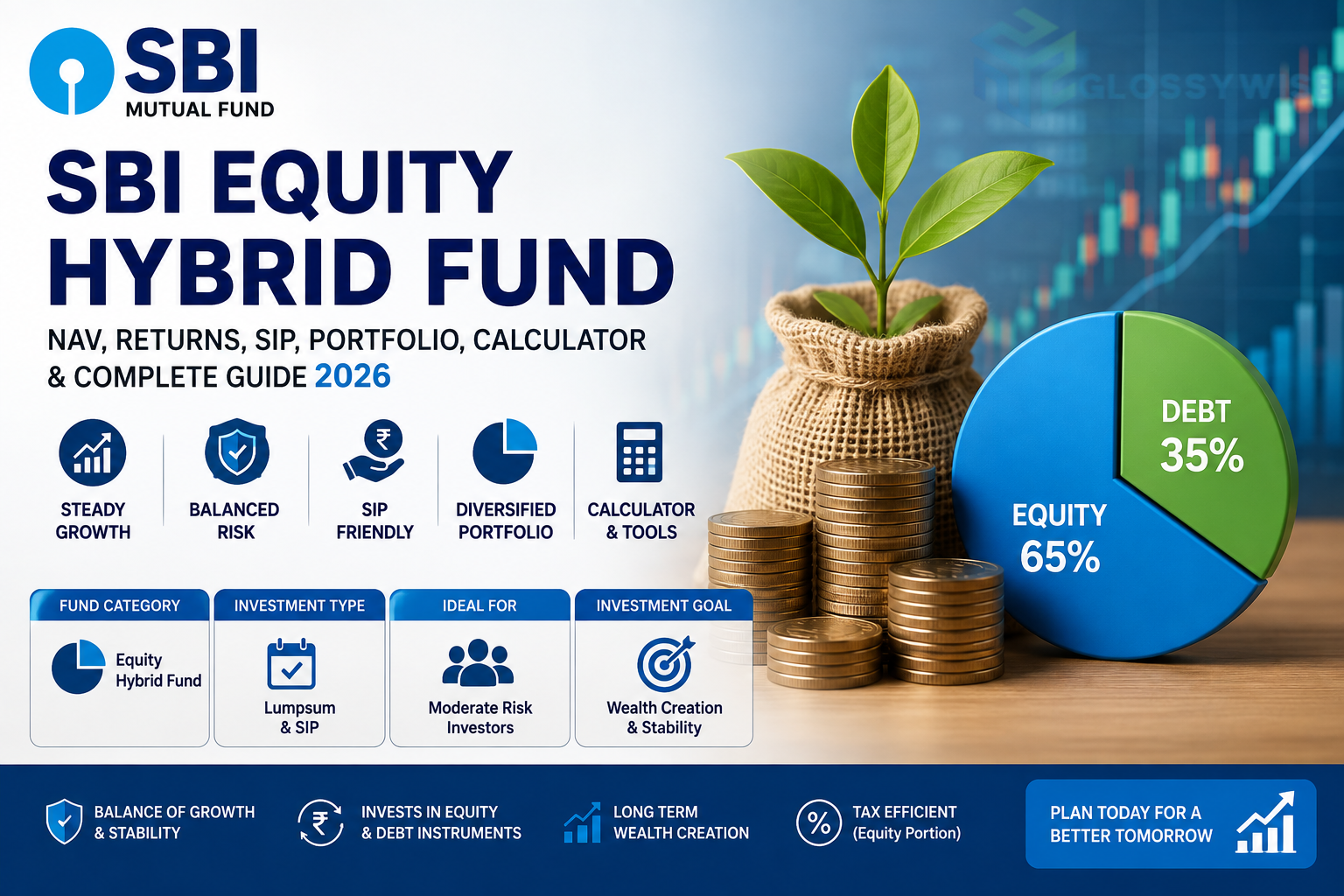
SBI Equity Hybrid Fund is one of the well-known hybrid mutual fund schemes from SBI Mutual Fund. The fund invests primarily in equity and equity-related securities while also maintaining exposure to debt and money-market instruments. This combination makes it different from a pure equity mutual fund because the portfolio is diversified across both equity and fixed-income assets. If you are searching for SBI Equity Hybrid Fund NAV today, SBI Mutual Fund returns 10 years, SBI Equity Hybrid Fund SIP, SBI mutual fund calculator, SBI mutual fund statement, best SBI mutual fund for lumpsum investment, or simply want to know whether the SBI Equity Hybrid Fund is a good investment, this guide explains the important details in simple language. According to SBI Mutual Fund’s official information, the scheme is an Aggressive Hybrid Fund and is intended for investors seeking long-term capital appreciation through investments primarily in equity and equity-related instruments with exposure to debt and money-market securities. Because mutual fund NAVs, portfolio holdings, AUM, and returns change over time, investors should always check the latest official SBI Mutual Fund information before making an investment decision.
What Is SBI Equity Hybrid Fund?
SBI Equity Hybrid Fund is an open-ended hybrid mutual fund managed by SBI Mutual Fund. Rather than investing entirely in shares, the scheme combines equity investments with debt and money-market instruments.
This structure is designed to provide investors with equity-market participation while maintaining a debt component in the portfolio. The fund is therefore different from a pure equity fund and also different from a traditional debt fund.
SBI Mutual Fund classifies hybrid mutual funds as schemes that can be used for regular income and capital appreciation, generally with a medium- to long-term investment approach.
The fund is suitable for investors who are comfortable with market fluctuations and are looking for long-term capital appreciation rather than guaranteed returns. SBI’s factsheet specifically states that investors should consult a financial adviser if they are uncertain about whether the product is suitable for them.
Read Also: How to Create a Personal Budget and Manage Your Finances
SBI Equity Hybrid Fund Name and Category
The scheme is currently known as SBI Equity Hybrid Fund and belongs to the Hybrid – Aggressive Hybrid Fund category.
The fund was previously known as SBI Magnum Balanced Fund. SBI Mutual Fund’s official expense-ratio disclosure identifies SBI Equity Hybrid Fund as the scheme previously known by that name.
This is useful for investors searching older records, statements, or historical performance data because older documents may show the previous scheme name.
The NAV, or Net Asset Value, represents the per-unit value of a mutual fund scheme. It changes as the value of the underlying portfolio changes.
For example, recent market data showed the SBI Equity Hybrid Fund Direct Plan-Growth NAV around ₹355.99 on 6 August 2026. NAV values can change every business day, so this figure should not be treated as today’s permanent NAV.
The best way to check the SBI mutual fund NAV today is through the latest NAV information provided by SBI Mutual Fund.
The important point is that a higher or lower NAV by itself does not tell you whether a mutual fund is expensive or cheap. Investors should examine returns, portfolio allocation, risk, costs,s and investment objectives instead.
NAV history can help investors understand how the value of their units has changed over different periods.
Recent NAV records show that the Direct Plan-Growth NAV moved from approximately ₹347 in late June 2026 to above ₹355 in early August 2026, illustrating how mutual fund NAVs can move with market conditions.
Short-term NAV movements should not normally be used as the only reason to invest or redeem. Hybrid funds are generally more appropriate for investors who can remain invested through different market cycles.
SBI Equity Hybrid Fund Returns
Returns are one of the most searched aspects of this scheme. However, the return you actually receive depends on the plan, option, investment date, holding period, and market conditions.
Recent data for the fund shows that its long-term performance has historically been stronger than many short-term periods, although past performance does not guarantee future returns.
A May 2026 product note reported historical returns of approximately 13.79% over 3 years, 11.35% over 5 years,s and 12.24% over 10 years for the data period shown in that document.
These numbers should be viewed as historical performance rather than a promised future return.
SBI Mutual Fund Returns 10 Years
The search term SBI mutual fund returns 10 years can refer to several SBI schemes, so it is important to specify the fund.
For SBI Equity Hybrid Fund, historical 10-year performance has been around the low-double-digit annualized range in available performance data. One May 2026 product document reported a 12.24% 10-year historical return for the fund.
A 10-year return figure is particularly useful because hybrid funds are generally intended for investors with a longer investment horizon. However, investors should compare the fund’s return with its benchmark and category rather than looking at the percentage alone.
SBI Equity Hybrid Fund Portfolio
The portfolio combines equity and fixed-income investments.
The May 2026 SBI factsheet showed approximately 74.00% in equity-related holdings, with the remainder spread across debt, government securities, certificates of deposit, securitised debt, cash and other instruments.
The portfolio is diversified across several sectors. Financial services represented one of the largest industry exposures, while power, consumer services, metals and mining, services, healthcare, oil and gas and telecommunications were also represented.
This diversification is one of the key characteristics of an aggressive hybrid fund.
SBI Equity Hybrid Fund Top Holdings

The portfolio includes investments in a range of companies and fixed-income securities.
Recent portfolio information has shown exposure to companies such as ICICI Bank, State Bank of India, Solar Industries India, Adani Energy Solutions, Adani Power, Kotak Mahindra Bank, Bharti Airtel, Bajaj Finance, MRF and HDFC Bank.
Portfolio holdings change over time, so investors should not assume that today’s top holdings will remain the same in the future.
SBI Equity Hybrid Fund Expense Ratio
The expense ratio is an important factor when comparing mutual funds.
According to SBI Mutual Fund’s May 2026 disclosure, the SBI Equity Hybrid Fund expense ratio was:
| Plan | Expense Ratio |
|---|---|
| Regular Plan | 1.31% |
| Direct Plan | 0.70% |
These figures were reported as of 31 May 2026.
The Direct Plan has a lower expense ratio because it does not include distributor commissions in the same way as the Regular Plan.
SBI Equity Hybrid Fund Direct Plan vs Regular Plan
SBI Equity Hybrid Fund is available in both Direct and Regular plans.
A Direct Plan is generally purchased directly from the fund house without a distributor, while a Regular Plan is purchased through a distributor or intermediary.
The difference in expense ratio can become meaningful over a long investment period because expenses affect the amount of money that remains invested.
For investors who are comfortable selecting and managing their mutual fund investments independently, a Direct Plan may be worth comparing with the Regular Plan. Investors who want distributor assistance may choose the Regular Plan.
SBI Equity Hybrid Fund Growth vs IDCW
The scheme also offers different options, including Growth and IDCW options.
Under a Growth option, gains generally remain invested in the scheme rather than being distributed as IDCW. Under an IDCW option, distributions may be made when declared, but they should not be confused with guaranteed interest or fixed income.
The NAV of an IDCW option can fall after a distribution because the distribution reduces the scheme’s assets per unit.
Investors should select the option based on their financial goals, tax situation and cash-flow requirements.
SBI Equity Hybrid Fund SIP
SIP, or Systematic Investment Plan, allows investors to invest a fixed amount at regular intervals rather than investing all the money at once.
SBI Equity Hybrid Fund supports SIP facilities. SBI’s current information also shows that the scheme has an Any Day SIP facility for monthly, quarterly, semi-annual and annual frequencies through electronic payment arrangements.
SIP can be useful for investors who receive regular income and want to build an investment gradually.
For example, instead of investing ₹1 lakh at one time, an investor could divide the investment into regular monthly contributions. This can reduce the risk of investing the entire amount immediately before a market decline, although SIP does not eliminate investment risk.
SBI Equity Hybrid Fund Minimum Investment
The scheme’s minimum investment amounts can vary by transaction type and may be updated by the fund house.
Recent scheme information indicates a minimum initial investment of ₹1,000 and a minimum additional investment of ₹1,000, while the minimum SIP investment is ₹500.
Investors should confirm the latest applicable amount before placing an order.
Best SBI Mutual Fund for Lumpsum Investment
There is no single SBI mutual fund that is automatically the best for every investor.
The right fund depends on the investor’s goal, time horizon, risk tolerance, investment amount,nt and need for liquidity.
SBI Equity Hybrid Fund may be considered by investors who want a combination of equity and debt exposure rather than investing a lump sum entirely in an equity fund. However, an aggressive hybrid fund can still experience significant market fluctuations because a substantial portion of its portfolio is invested in equity.
Someone looking for a lumpsum investment should therefore compare the SBI Equity Hybrid Fund with other SBI equity, hybrid and debt schemes according to their personal requirements rather than choosing solely based on historical returns.
Is SBI Equity Hybrid Fund Good for Lumpsum Investment?
It can be suitable for some investors, but there is no universal answer.
A lumpsum investment can perform well when markets rise, but it can also experience an immediate decline if markets fall shortly after the investment is made.
Investors with a long horizon and the ability to tolerate market volatility may find the fund’s equity-plus-debt structure attractive. Investors who need the money soon or cannot tolerate fluctuations may need to consider lower-risk alternatives.
SBI Mutual Fund Statement
An SBI Mutual Fund statement provides information about transactions and holdings associated with an investor’s mutual fund account.
The statement can help investors review purchases, redemptions, SIP transactions, units held, and other account information.
SBI Mutual Fund provides investor services for account-related requirements, including a Statement of Account service through its online investor-service platform.
Investors should use the official SBI Mutual Fund investor-service channels when requesting statements or dealing with account information.
How to Get SBI Mutual Fund Statement
Investors generally need to use the official SBI Mutual Fund investor-service facilities and provide the information required to authenticate their account.
A statement is useful for checking whether SIP instalments were processed correctly and for reviewing historical transactions.
If an investor has investments through another platform or intermediary, the statement may also be available through that platform.
SBI Mutual Fund Login With PAN Number
Many investors search for SBI mutual fund login with PAN number when trying to access their investment information.
PAN is an important identifier in India’s mutual fund system, but investors should not enter their PAN or other sensitive information into unofficial websites.
Use the official SBI Mutual Fund investor portal or the official platform associated with your investment account. SBI Mutual Fund provides investor services including account updates, KYC status, statement-related services and other transaction facilities.
If you cannot access your account, use the official customer-support or account-recovery process rather than sharing your PAN, OTP or password with another person.
SBI Mutual Fund Calculator
A mutual fund calculator can help investors estimate the potential future value of an SIP or lumpsum investment.
SBI Mutual Fund provides several calculators, including a SIP Calculator, Returns Calculator, Retirement Calculator, Top-up SIP Calculator, STP Calculator and SWP Calculator through its official website.
For example, an investor could enter a monthly SIP amount, expected annual return and investment duration to estimate a potential future value.
The result is only an illustration. Mutual fund returns are market-linked, and actual returns can be higher or lower than the assumed rate used in a calculator.
SBI Mutual Fund App
Investors may also search for the SBI mutual fund app when looking for a convenient way to manage investments.
SBI Mutual Fund provides digital investor services for transactions and account management. Investors should download or access the official application or platform through trusted official channels rather than installing an app from an unknown source.
Before entering PAN details, bank information, passwords, or OTPs, always verify that you are using the legitimate SBI Mutual Fund service.
SBI Mutual Fund Interest Rate Today
The phrase SBI mutual fund interest rate today can be misleading.
Mutual funds do not offer a fixed daily interest rate in the same way as a fixed deposit. SBI Equity Hybrid Fund is market-linked, meaning its NAV and returns can rise or fall according to the performance and valuation of the securities in its portfolio.
Therefore, there is no guaranteed SBI Equity Hybrid Fund interest rate today.
Investors should look at NAV, annualized returns, rolling returns, portfolio allocation,n and risk rather than searching for a fixed interest rate.
Is SBI Hybrid Equity Fund a Good Investment?
The answer depends on the investor.
SBI Equity Hybrid Fund may be attractive to investors who want equity exposure combined with debt investments and who can tolerate market volatility over a longer period.
The fund has a substantial equity allocation, so it should not be treated as a guaranteed-return product. The official SBI factsheet states that the scheme is intended for investors seeking long-term capital appreciation and invests primarily in equity and equity-related instruments with exposure to debt and money-market instruments.
Investors should consider their goals, risk profile and investment horizon before investing.
Which SBI Hybrid Mutual Fund Is the Best?
There is no objectively best SBI hybrid mutual fund for everyone.
SBI offers different hybrid-oriented solutions designed for different objectives and risk levels. An aggressive hybrid fund such as SBI Equity Hybrid Fund is more equity-oriented and therefore generally carries greater market exposure than a conservative hybrid strategy.
The best choice depends on whether an investor prioritizes growth, income, lower volatility or a particular financial goal.
Comparing asset allocation, historical performance, expense ratio, risk level and investment horizon is more useful than selecting a fund simply because it has the word “best” in a search result.
Which Equity Hybrid Fund Is Best?
There is also no universally best equity hybrid fund.
Different investors may reach different conclusions based on return consistency, portfolio construction, expense ratio, fund management, downside protection and risk-adjusted performance.
SBI Equity Hybrid Fund is a long-running aggressive hybrid scheme, but investors should compare it against other funds in the same category before investing.
A good comparison should include at least 3-year, 5-year and 10-year performance where available, benchmark performance, portfolio allocation, expense ratio and risk characteristics.
SBI Equity Hybrid Fund Risk
Although the fund contains debt investments, it is not a low-risk investment.
Because the scheme invests substantially in equity, its NAV can fall when stock markets decline.
The current product classification and risk information should therefore be checked before investing. Third-party fund data currently identifies the scheme’s riskometer as Very High, illustrating why investors should not treat the fund as equivalent to a bank deposit.
The debt portion can provide diversification, but it does not eliminate market risk.
SBI Equity Hybrid Fund Exit Load
The scheme has an exit-load structure for early redemption.
According to the May 2026 SBI factsheet, for redemptions within 12 months from allotment, there is no exit load on the first 10% of the investment, while the remaining investment may attract a 1% exit load. After 12 months, the exit load is nil.
Investors should check the latest scheme documents before redeeming because fund-house terms can be updated.
SBI Equity Hybrid Fund Asset Allocation
Asset allocation is one of the most important characteristics of the scheme.
Recent portfolio information showed approximately:
| Asset Category | Approximate Allocation |
|---|---|
| Equity and equity-related | 74% |
| Debt and related instruments | Around 20%+ |
| Cash and other holdings | Remaining allocation |
The exact percentages change as the portfolio is rebalanced and market values move. The May 2026 factsheet reported 74.00% equity-related exposure and 5.79% cash, cash equivalents and others, with the remaining assets distributed across debt and other instruments.
SBI Equity Hybrid Fund Market Capitalization Exposure
The equity portion is diversified across large-cap, mid-cap and small-cap companies.
The March 2026 factsheet showed approximately 57.07% large-cap, 15.55% mid-cap and 2.38% small-cap exposure in its portfolio classification.
This provides exposure across different sections of the equity market rather than concentrating the entire equity allocation in one market-cap segment.
SBI Equity Hybrid Fund Taxation
Mutual fund taxation depends on the fund’s classification, holding period, transaction date, te and applicable Indian tax rules.
Because tax regulations can change, investors should not rely on an old tax calculation when making a large investment.
Before investing or redeeming a substantial amount, investors should check the latest applicable tax rules or consult a qualified tax professional.
SBI Equity Hybrid Fund vs Pure Equity Fund
The biggest difference is asset allocation.
A pure equity fund generally invests predominantly in shares, while an aggressive hybrid fund combines equity with debt and money-market investments.
SBI Equity Hybrid Fund can therefore provide diversification between the two asset classes, but it may also deliver lower upside than a pure equity fund during a strong equity-market rally.
On the other hand, the debt allocation can provide a different source of return and may help diversify the portfolio during some market conditions.
SBI Equity Hybrid Fund vs Fixed Deposit
A fixed deposit generally provides a predetermined interest rate subject to the terms of the deposit, whereas SBI Equity Hybrid Fund provides market-linked returns.
A mutual fund can generate higher or lower returns than a fixed deposit, but it does not guarantee a particular return.
Investors looking for capital protection and predictable interest should understand this difference before choosing a mutual fund.
Who Should Consider SBI Equity Hybrid Fund?
SBI Equity Hybrid Fund may be considered by investors who:
- Want both equity and debt exposure in one scheme
- Have a medium- to long-term investment horizon
- Can tolerate market volatility
- Want professional portfolio management
- Prefer a hybrid approach instead of investing separately in equity and debt funds
It may be less appropriate for someone who needs guaranteed returns or expects to withdraw the entire investment in the near future.
Who Should Avoid SBI Equity Hybrid Fund?
No investment is suitable for every person.
Investors who cannot tolerate substantial fluctuations in portfolio value may want to consider alternatives with lower equity exposure.
Likewise, someone investing money that is needed for an immediate financial obligation should generally avoid taking unnecessary market risk with that money.
The fund’s high-risk market profile means investors should understand the possibility of losses before investing.
SBI Equity Hybrid Fund: Advantages
One major advantage is diversification.
Instead of investing solely in stocks, the fund combines equity with debt and money-market instruments. This gives investors access to multiple asset classes through one scheme.
Another advantage is professional management. The portfolio is managed by the fund house rather than requiring the investor to select individual shares and bonds.
The scheme also offers SIP and lump-sum investment routes, allowing investors to choose an investment method that suits their cash flow.
SBI Equity Hybrid Fund: Disadvantages
The biggest disadvantage is that the fund is still exposed significantly to equity-market risk.
The NAV can fall during market corrections, and historical returns cannot guarantee future performance.
There are also expenses associated with managing the scheme, and investors using the Regular Plan pay a higher expense ratio than the Direct Plan according to SBI’s May 2026 disclosure.
SBI Equity Hybrid Fund for Long-Term Investment
The fund is designed around long-term capital appreciation, making a longer holding period more appropriate than short-term trading.
SBI’s official factsheet explicitly identifies long-term capital appreciation as an investment objective.
Investors should therefore focus on long-term performance and portfolio quality instead of reacting to every daily NAV movement.
SBI Equity Hybrid Fund 5-Year and 10-Year Returns
Long-term returns are particularly useful when evaluating a hybrid fund.
Available historical data reported approximately 11.35% annualized over 5 years and 12.24% over 10 years in the May 2026 product information.
However, these historical figures should not be interpreted as an expected guaranteed annual return. Future market conditions, interest rates, portfolio allocation,n and economic conditions can produce different results.
SBI Equity Hybrid Fund SIP vs Lumpsum
SIP and lumpsum investments have different characteristics.
With SIP, money is invested gradually, which means the investor buys units at different NAV levels over time.
With a lumpsum investment, the entire amount is invested at once. If markets rise afterward, the investor can benefit from the full exposure, but if markets decline, the entire investment is exposed immediately.
Investors should choose between the two based on their cash availability, investment horizon, and risk tolerance.
How to Invest in SBI Equity Hybrid Fund
Investors can generally invest through SBI Mutual Fund’s official digital investment facilities or through authorized mutual fund platforms and intermediaries.
Before investing, select the appropriate plan, option, investment amount, and transaction method.
Investors should also make sure that their KYC requirements are complete and that their bank and PAN information are accurate.
Always verify the fund name and plan before confirming an investment because SBI Mutual Fund offers several schemes with similar names.
To check the latest NAV, use SBI Mutual Fund’s official NAV service or the fund’s official scheme page.
NAV information changes regularly, so an article or third-party page showing yesterday’s NAV may not represent the current value.
SBI Mutual Fund’s website provides a dedicated NAV section and also allows investors to check fund-related information.
How to Check SBI Equity Hybrid Fund Returns
Investors should compare returns across several periods rather than focusing on one short period.
Useful periods include:
- 1 year
- 3 years
- 5 years
- 10 years
- Since inception
It is also useful to compare the fund against its benchmark and category average.
A fund that performs well over one year but inconsistently over longer periods may require more careful analysis.
SBI Equity Hybrid Fund Benchmark
The scheme is benchmarked against a hybrid index designed to represent an aggressive hybrid portfolio.
Benchmark comparisons are important because a fund’s return should be evaluated against the type of portfolio it is designed to manage.
SBI’s official performance disclosures also explain that performance is benchmarked to the Total Return variant of the relevant index.
Final Verdict on SBI Equity Hybrid Fund
SBI Equity Hybrid Fund is a major aggressive hybrid mutual fund that combines equity and debt exposure under one scheme.
Its substantial equity allocation gives it meaningful growth potential, while its debt and money-market exposure provides diversification. The scheme has a long operating history and is backed by SBI Mutual Fund, but that does not mean returns are guaranteed.
The most important figures to monitor are the latest SBI Equity Hybrid Fund NAV, portfolio allocation, expense ratio, historical returns, benchmark performance and risk level.
For investors researching SBI mutual fund returns 10 years, SBI mutual fund NAV today, SBI mutual fund statement, SBI mutual fund calculator, SBI mutual fund app, or best SBI mutual fund for lumpsum investment, the key lesson is that the right choice depends on the investor’s personal objective rather than one headline return number.
SBI Mutual Fund’s own documentation makes clear that mutual fund investments are subject to market risks and that investors should read the scheme-related documents carefully.
Frequently Asked Questions About SBI Equity Hybrid Fund
What is the new name of the SBI Equity Hybrid Fund?
The current name is SBI Equity Hybrid Fund. The scheme was previously known as SBI Magnum Balanced Fund. SBI Mutual Fund’s official expense-ratio disclosure confirms the previous name.
Is SBI Hybrid Equity Fund a good investment?
It can be suitable for investors seeking long-term capital appreciation and who are comfortable with high market risk. It invests substantially in equity while also maintaining debt and money-market exposure. However, it is not a guaranteed-return investment, and suitability depends on the investor’s goals and risk tolerance.
Which SBI hybrid mutual fund is the best?
There is no single best SBI hybrid fund for every investor. SBI Equity Hybrid Fund may suit investors seeking an aggressive hybrid strategy, while other hybrid schemes may be more appropriate for investors looking for different levels of equity exposure or lower volatility.
Which equity hybrid fund is best?
The best equity hybrid fund depends on factors such as long-term returns, consistency, benchmark performance, portfolio allocation, expense ratio and risk. Investors should compare several funds rather than choosing only from a one-year return ranking.
The NAV changes on each business day. Recent data showed the Direct Plan-Growth NAV around ₹355.99 on 6 August 2026, but investors should check the latest official SBI Mutual Fund NAV before making a transaction.
What are the SBI Equity Hybrid Fund 10-year returns?
Available May 2026 historical performance data reported approximately 12.24% annualized over 10 years. Historical returns are not guaranteed future returns.
Can I invest in SBI Equity Hybrid Fund through SIP?
Yes. The scheme supports SIP investment, and SBI’s factsheet describes Any Day SIP facilities for monthly, quarterly, semi-annual and annual frequencies.
What is the minimum SIP amount for SBI Equity Hybrid Fund?
Recent scheme information lists the minimum SIP investment at ₹500, while the minimum initial investment is ₹1,000. Investors should confirm the current amount before investing.
What is the expense ratio of SBI Equity Hybrid Fund?
As of 31 May 2026, SBI Mutual Fund reported an expense ratio of 1.31% for the Regular Plan and 0.70% for the Direct Plan.
Does SBI Equity Hybrid Fund have an exit load?
Yes. The May 2026 factsheet states that redemptions within 12 months can attract a 1% exit load on units beyond 10% of the investment, while the applicable exit load after 12 months is nil.
Is SBI Equity Hybrid Fund safe?
It should not be considered a guaranteed or risk-free investment. The fund has substantial equity exposure and can experience market-related losses. Recent third-party fund information classifies its riskometer as Very High.
Is SBI Equity Hybrid Fund good for long-term investment?
The fund’s stated objective is long-term capital appreciation, so it is designed with a longer investment horizon in mind. Investors should nevertheless consider their own risk tolerance and financial goals before investing.
Conclusion
SBI Equity Hybrid Fund is an aggressive hybrid mutual fund that combines equity and debt exposure for investors looking for long-term capital appreciation. The fund can be relevant for people searching for SBI Equity Hybrid Fund NAV, SBI mutual fund returns 10 years, SBI mutual fund SIP, SBI mutual fund calculator, SBI mutual fund statement, SBI mutual fund login with PAN number,r and SBI mutual fund app. The scheme’s substantial equity allocation means that investors must be prepared for market fluctuations. Its historical returns can help with research, but they should never be treated as guaranteed future performance. Before investing, check the latest SBI Mutual Fund factsheet, NAV, portfolio, expense ratio riskometerr, riskometer, and applicable scheme documents. Mutual fund investments are subject to market risks, and investors should make decisions according to their own financial situation and investment objectives.
