
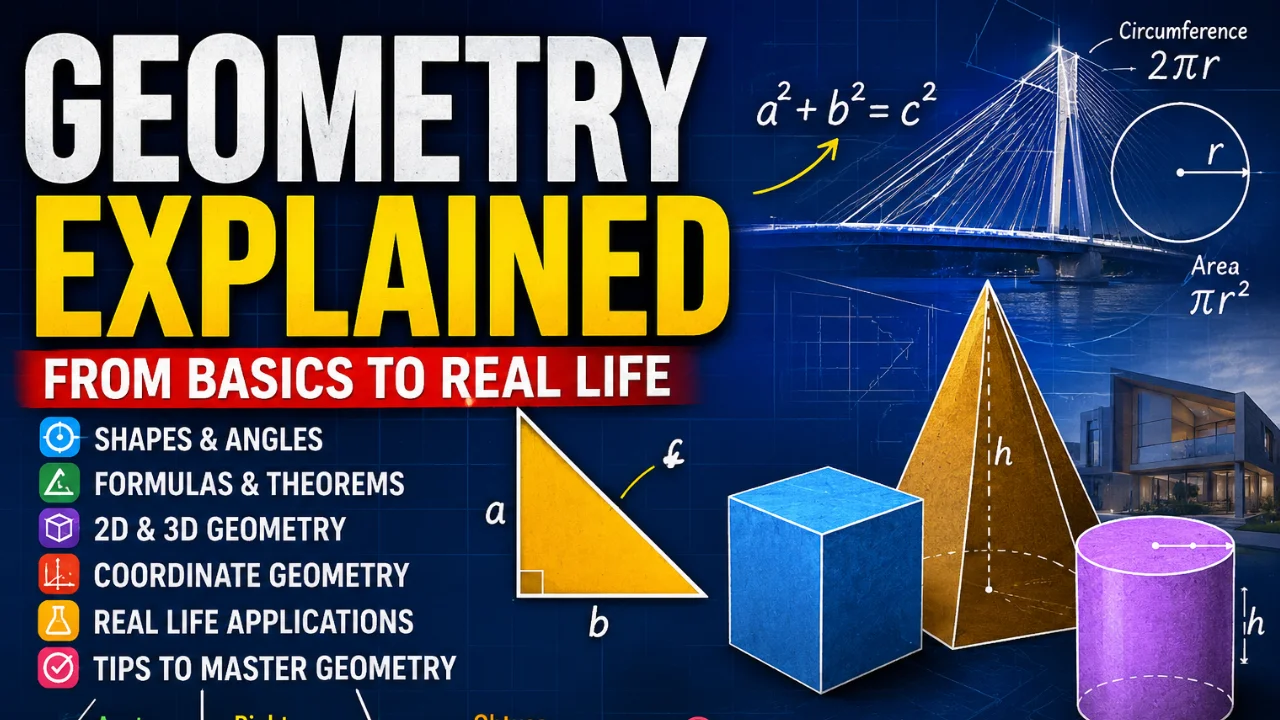
Geometry Learn V3 is everywhere. The screen you’re reading this on, the room you’re sitting in, the road you drove on — all of it is built on geometric principles.
Most people think geometry is just about triangles in a textbook. But in real life, geometry helps engineers design bridges, architects plan buildings, artists create perfect proportions, and even game developers build 3D worlds.
If you’ve been avoiding Geometry Learn V3 because it feels complicated — this guide is going to change that. We’re going to break it down in plain English, step by step, so it actually makes sense.
The Basic Building Blocks of Geometry Learn V3
Before jumping into theorems and formulas, you need to know the foundation. Geometry Learn V3 starts with just three ideas.
Points, Lines, and Planes
A point is just a location in space. It has no size, no width — it’s just a position. We label it with a dot and a letter, like point A.
A line is an infinite collection of points going in both directions. It never ends. A line segment is a piece of a line — it has two endpoints.
A plane is a flat, two-dimensional surface that extends forever in all directions. Think of it like an infinite sheet of paper.
These three things — point, line, plane — are the starting blocks of all of geometry.
Types of Angles You Must Know
Angles show up in almost every Geometry Learn V3 problem. Here’s what each one means, in simple terms.
Acute, Right, Obtuse, and Straight Angles
| Angle Type | Measurement | Real-World Example |
|---|---|---|
| Acute | Less than 90° | A slice of pizza |
| Right | Exactly 90° | Corner of a book |
| Obtuse | Between 90°–180° | An open laptop screen |
| Straight | Exactly 180° | A flat road |
| Reflex | More than 180° | The large part of a clock hand sweep |
In real use, right angles are probably the most important. Almost all construction and carpentry is based around making sure corners are exactly 90 degrees.
Complementary and Supplementary Angles
Two angles that add up to 90° are called complementary. Two angles that add up to 180° are supplementary.
This sounds simple, but these relationships are used constantly in solving geometry problems. If you know one angle, you can often find the other just by subtracting.
2D Shapes: Polygons and Their Properties
A polygon is any closed flat shape made of straight lines. Triangles, squares, pentagons — they’re all polygons.
Triangles: The Most Important Shape in Geometry Learn V3
Triangles are the foundation of geometry. They’re studied more than any other shape because they’re the strongest and most stable form in nature.
There are three main types:
- Equilateral triangle — all three sides equal, all angles are 60°
- Isosceles triangle — two sides equal, two base angles equal
- Scalene triangle — no sides equal, no angles equal
One rule applies to every single triangle on earth: all three interior angles always add up to 180°. That’s a universal truth in flat geometry.
Quadrilaterals: Four-Sided Shapes
Any shape with four sides is a quadrilateral. Here are the common ones:
- Square — four equal sides, all angles 90°
- Rectangle — opposite sides equal, all angles 90°
- Parallelogram — opposite sides parallel and equal
- Rhombus — four equal sides, opposite angles equal
- Trapezoid — one pair of parallel sides
What usually happens is students confuse squares and rectangles. Here’s the thing — every square is a rectangle, but not every rectangle is a square.
Other Common Polygons
- Pentagon — 5 sides (used in U.S. military headquarters building design)
- Hexagon — 6 sides (bees build honeycombs in hexagons because it’s the most efficient shape)
- Octagon — 8 sides (stop signs worldwide use this shape)
Perimeter and Area: Measuring 2D Shapes
Once you know the shape, the next step is measuring it.
Perimeter is the total distance around the outside of a shape. You find it by adding up all the side lengths.
Area is the space inside a shape. Each shape has its own formula.
Key Area Formulas
| Shape | Area Formula |
|---|---|
| Square | side × side (s²) |
| Rectangle | length × width |
| Triangle | ½ × base × height |
| Circle | π × radius² |
| Parallelogram | base × height |
| Trapezoid | ½ × (sum of parallel sides) × height |
From experience, the triangle formula trips people up the most. Remember — you need the perpendicular height, not the slanted side.
Circles: A World of Their Own
Circles are different from polygons. They have no straight sides, no corners. And they come with their own set of important terms.
- Radius — distance from center to edge
- Diameter — distance across the full circle (= 2 × radius)
- Circumference — the perimeter of a circle = 2πr
- Chord — any line segment connecting two points on the circle
- Arc — a curved portion of the circle’s edge
- Sector — a “slice” of the circle (like a pizza slice)
The number π (pi) is approximately 3.14159. It’s the ratio of a circle’s circumference to its diameter — and this ratio is the same for every circle, no matter the size. That’s one of the most beautiful facts in all of mathematics.
The Pythagorean Theorem: The Most Famous Rule in Geometry
If there’s one formula every student must know, it’s this one.
a² + b² = c²
This applies to right triangles only. Here, c is the hypotenuse (the longest side, opposite the right angle), and a and b are the other two sides.
Practical example: You need to know the length of a ladder leaning against a wall. The wall is 4 meters high, and the base of the ladder is 3 meters from the wall. What’s the ladder length?
4² + 3² = c² 16 + 9 = 25 c = 5 meters
This exact calculation is used by construction workers every day. Pythagoras lived around 570–495 BC, and his theorem still runs the world of building and engineering.
Congruence and Similarity: Are Shapes the Same?
Two shapes are congruent if they are exactly the same — same size, same shape. Two shapes are similar if they have the same shape but different sizes.
Think of a photo and its thumbnail. The thumbnail is similar to the original — same proportions, just smaller.
Triangle Congruence Rules (Short Version)
- SSS — all three sides equal
- SAS — two sides and the included angle equal
- ASA — two angles and the included side equal
- AAS — two angles and a non-included side equal
- RHS — right angle, hypotenuse, and one side equal (right triangles only)
These rules let you prove two triangles are identical without measuring every single part. That’s powerful in both math and real engineering.
3D Geometry: Shapes in Space
Flat geometry is 2D. But the real world is three-dimensional. That’s where 3D geometry comes in.
Common 3D Shapes
- Cube — 6 equal square faces
- Cuboid (rectangular prism) — like a box
- Sphere — perfectly round, like a ball
- Cylinder — two circular bases connected by a curved surface
- Cone — one circular base narrowing to a point
- Pyramid — polygon base with triangular sides meeting at a point
Volume Formulas
| Shape | Volume Formula |
|---|---|
| Cube | s³ |
| Cuboid | l × w × h |
| Sphere | (4/3) × π × r³ |
| Cylinder | π × r² × h |
| Cone | (1/3) × π × r² × h |
Volume tells you how much space something takes up — crucial for packaging design, architecture, medicine dosing, and more.
Coordinate Geometry: Geometry Meets Algebra
Coordinate geometry connects geometry with a number system. You plot points on an X-Y grid and use algebra to study shapes and lines.
Key Ideas
- Every point is written as (x, y)
- The origin is (0, 0), where the X and Y axes cross
- Distance formula between two points: √[(x₂−x₁)² + (y₂−y₁)²]
- Midpoint formula: [(x₁+x₂)/2, (y₁+y₂)/2]
- Slope of a line: (y₂−y₁) ÷ (x₂−x₁)
This system was developed by René Descartes in the 1600s. It’s why GPS works, why computer graphics exist, and how Google Maps calculates routes.
Transformations: Moving Shapes Around
A transformation moves or changes a shape while keeping its structure.
- Translation — slide the shape (same size, same orientation)
- Rotation — turn the shape around a point
- Reflection — flip the shape across a line (mirror image)
- Dilation — scale the shape up or down
These concepts are literally what video game engines and animation software use to move characters across a screen.
Geometry in Real Life: Why This Actually Matters
Here’s what really matters — geometry is not just school math. It’s applied everywhere.
- Architecture — Floor plans use coordinate geometry, load-bearing walls use triangle strength
- Navigation — GPS triangulation uses geometric calculations
- Art and Design — The golden ratio is a geometric concept behind beautiful design
- Medical Imaging — MRI and CT scans reconstruct 3D geometry from 2D images
- Sports — Trajectory of a ball, angle of a shot — all geometry
- Robotics — Robot arms use geometric angles to move precisely
NASA uses geometry to calculate spacecraft trajectories. Architects like Zaha Hadid built careers on geometric innovation. Even Instagram uses geometry to crop and resize images.
How to Geometry Learn V3 Effectively: A Simple Guide
A lot of people struggle with geometry not because it’s hard — but because they skip the basics and jump to formulas.
Here’s a practical approach that actually works:
Step 1: Start with shapes and definitions. Don’t memorize formulas yet. Just understand what each shape is and how it’s different from others.
Step 2: Learn angle relationships. Understand complementary, supplementary, vertical, and corresponding angles. These show up in almost every problem.
Step 3: Practice drawing. Sketching the shape before solving helps enormously. Even a rough drawing helps you see what’s going on.
Step 4: Memorize only the core formulas. Area of a triangle, Pythagorean theorem, circle formulas. The rest you can derive.
Step 5: Solve real problems. Don’t just read examples — solve them yourself. Use graph paper, draw it out, work through it step by step.
Step 6: Connect it to real life. When you see a building, think about the angles. When you see a road curve, think about arcs. This builds genuine understanding.
Free tools like Khan Academy, GeoGebra, and Desmos make geometry interactive and visual — great for self-learners.
Common Geometry Mistakes (And How to Avoid Them)
Mistake 1: Confusing perimeter and area. Perimeter is the outside edge. Area is the inside space. They’re completely different things.
Mistake 2: Using the wrong height in triangle area. Always use the perpendicular height — the one that forms a 90° angle with the base.
Mistake 3: Applying Pythagorean theorem to non-right triangles. This formula only works when there’s a 90° angle.
Mistake 4: Mixing up radius and diameter. Diameter is always twice the radius. This mistake ruins circle calculations instantly.
Mistake 5: Forgetting units. Area is always in square units (cm², m²). Volume is always in cubic units (cm³, m³). Missing this costs marks.
Conclusion
Geometry Learn V3 is one of the most practical branches of mathematics. From the buildings we live in to the technology we use every day, geometric thinking is everywhere.
The good part is — once you understand the basics, everything else builds naturally on top. Start with shapes and angles, move to formulas, then apply it to real problems.
You don’t need to be a math genius to get good at geometry. You just need the right foundation and consistent practice.
FAQs About Geometry Learn V3
Q1: What is geometry in simple words?
Geometry Learn V3 explains geometry as the branch of mathematics that studies shapes, sizes, angles, and the properties of space — including both flat (2D) and solid (3D) figures.
Q2: What are the basic topics in geometry?
In Geometry Learn V3, the core topics include points, lines, angles, 2D shapes (like triangles, circles, and polygons), 3D shapes, area, perimeter, volume, coordinate geometry, and transformations.
Q3: Why is the Pythagorean theorem important?
Geometry Learn V3 highlights that the Pythagorean theorem is essential for finding a missing side in a right triangle. It is widely used in construction, navigation, architecture, and physics.
a2+b2=c2
a
b
c=a2+b2≈21.21
a2+b2=c2≈225.00+225.00=450.00abc
Q4: How do I get better at geometry?
To improve with Geometry Learn V3, practice drawing shapes, understand angle relationships, memorize key formulas, and solve problems regularly. Using tools like GeoGebra and Khan Academy can also boost your learning.
Q5: What is coordinate geometry used for?
Geometry Learn V3 shows that coordinate geometry is used in GPS systems, computer graphics, game development, mapping software, and engineering design.
Q6: Is geometry hard to learn?
With Geometry Learn V3, geometry becomes easier when you start from the basics. Many learners struggle because they skip foundational concepts. Build your understanding step by step for better results.
