
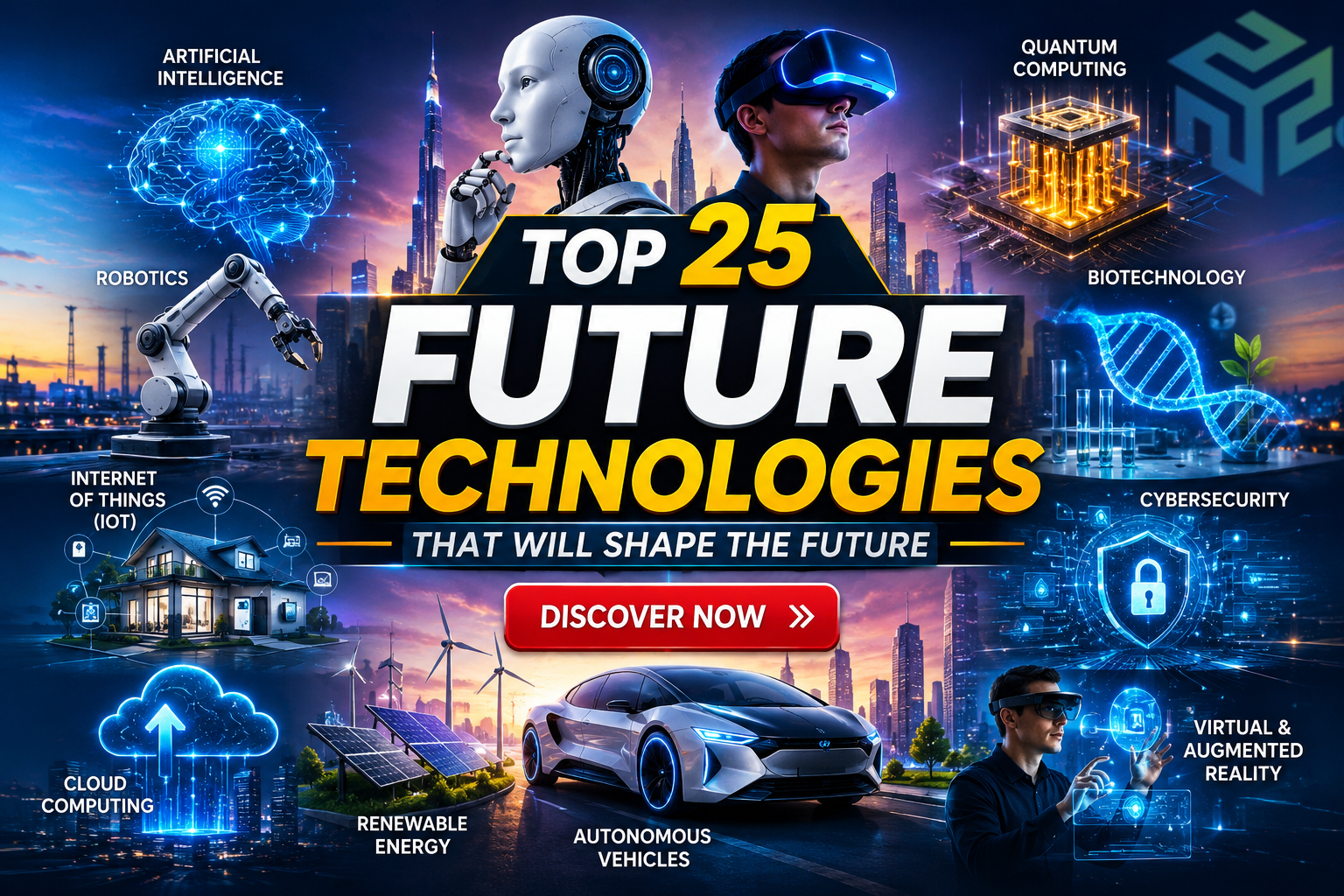
Technology is evolving faster than ever before. Every year, new inventions and digital innovations change the way we communicate, work, travel, study, and even receive healthcare. Many of the technologies that once seemed impossible are now becoming part of everyday life. Future technologies are expected to solve complex problems, improve business productivity, and make life easier for people around the world. From artificial intelligence and quantum computing to robotics and biotechnology, these innovations are creating exciting opportunities for individuals and organizations alike.
We’ll explore the top future technologies that are expected to shape the future and explain how each one could transform our lives in the coming years.
What Are Future Technologies?
Future technologies are advanced innovations that are currently being developed or rapidly improved. These technologies have the potential to change industries, create new jobs, improve healthcare, increase productivity, and solve global challenges.
Many of these technologies already exist today, but they are expected to become much more powerful and widely available over the next decade.
Why Are Future Technologies Important?
Future technologies are changing the way people live, work, and communicate. They help solve everyday problems, improve efficiency, and create new opportunities for individuals, businesses, and governments. As innovation continues, these technologies will play an even bigger role in shaping the future.
Some of the key benefits of future technologies include:
- Faster and more reliable communication
- Better healthcare through advanced medical technology
- Smarter and safer transportation systems
- Improved education with digital learning tools
- Higher productivity for businesses and employees
- Stronger online security and data protection
- Cleaner and more sustainable energy solutions
- More efficient manufacturing with automation and AI
As technology continues to evolve, learning about these innovations can help people prepare for the future.
1- Artificial Intelligence -AI
Artificial Intelligence is one of the fastest-growing technologies in the world. AI allows computers to perform tasks that normally require human intelligence, such as learning, problem-solving, language understanding, and image recognition.
Today, AI is used in chatbots, virtual assistants, healthcare, finance, marketing, and customer service.
Benefits
- Automates repetitive work
- Improves business efficiency
- Provides personalized recommendations
- Helps doctors diagnose diseases
- Supports smarter decision-making
2- Machine Learning
Machine Learning is a branch of Artificial Intelligence that enables computers to learn from data without being directly programmed. Popular platforms like Netflix, YouTube, and Amazon use machine learning to recommend content and products based on user behavior.
Benefits
- Better predictions
- Personalized experiences
- Fraud detection
- Business automation
3- Quantum Computing
Quantum computing is a new type of computing that can solve complex problems much faster than traditional computers. Although still developing, quantum computers could revolutionize medicine, cybersecurity, scientific research, and financial analysis.
Benefits
- Faster calculations
- Better scientific research
- Advanced encryption
- Improved drug discovery
4- Robotics
Robotics
Robotics is advancing rapidly, making machines more intelligent, efficient, and capable of performing complex tasks. Today, robots are widely used in industries such as manufacturing, healthcare, agriculture, logistics, and home automation. As technology continues to improve, future robots will work more closely with humans, handling repetitive, time-consuming, and hazardous tasks while increasing overall efficiency.
Benefits
- Increases productivity and efficiency
- Improves workplace safety
- Speeds up manufacturing processes
- Delivers greater accuracy and precision
5- Internet of Things -IoT
The Internet of Things (IoT) is a technology that connects everyday devices to the internet, allowing them to communicate, collect data, and perform tasks automatically. From smart home appliances to wearable devices, IoT is making daily life more convenient while helping businesses improve efficiency and decision-making.
Common examples of IoT devices include smart TVs, smart refrigerators, fitness trackers, security cameras, smart thermostats, and connected home systems.
Benefits
- Creates smarter and more connected homes
- Helps reduce energy consumption
- Enhances security and safety
- Enables remote monitoring and control
6- 5G and Future 6G Networks
5G internet has already improved mobile communication by providing faster speeds and lower delays. Future 6G technology is expected to offer even faster internet, supporting advanced virtual reality, smart cities, and autonomous vehicles.
Benefits
- Faster downloads
- Better video calls
- Improved gaming
- Stronger connectivity
7- Blockchain Technology
Blockchain is a secure digital system used to store information across multiple computers. While it became popular through cryptocurrencies, blockchain is now being used in banking, healthcare, supply chain management, and digital identity systems.
Benefits
- Better security
- Transparent transactions
- Reduced fraud
- Faster payments
8- Cybersecurity Technologies
As cyber threats continue to increase, cybersecurity is becoming one of the most important future technologies. Modern cybersecurity tools use artificial intelligence to detect attacks before they cause damage.
Benefits
- Data protection
- Privacy improvement
- Safe online transactions
- Business security
Virtual Reality -VR
Virtual Reality creates immersive digital environments that users can explore using special headsets. VR is widely used in gaming, education, healthcare training, architecture, and virtual tourism.
Benefits
- Better learning
- Realistic simulations
- Interactive entertainment
- Remote training
Augmented Reality (AR)
Unlike Virtual Reality, Augmented Reality adds digital information to the real world through smartphones or smart glasses. Many shopping apps now allow customers to place virtual furniture inside their homes before buying.
Benefits
- Better shopping experiences
- Interactive education
- Improved navigation
- Enhanced workplace training
Biotechnology
Biotechnology combines biology and technology to improve healthcare, agriculture, and environmental protection. Scientists are developing better medicines, disease treatments, and sustainable farming methods using biotechnology.
Benefits
- Better healthcare
- Improved food production
- Disease prevention
- Environmental protection
Green Technology
Green technology focuses on reducing pollution while protecting natural resources. Solar energy, wind power, electric vehicles, and sustainable manufacturing are examples of green technology shaping a cleaner future.
Benefits
- Cleaner environment
- Renewable energy
- Reduced carbon emissions
- Sustainable development
13. Cloud Computing
Cloud computing allows individuals and businesses to store, manage, and access data over the internet instead of relying on physical storage devices. It provides flexibility, reduces costs, and makes collaboration easier from anywhere in the world.
Benefits
- Easy access to data from any location
- Lower IT and storage costs
- Improved collaboration
- Secure data backup and recovery
14. Edge Computing
Edge computing processes data closer to where it is created instead of sending it to a central cloud server. This reduces delays and improves the speed of connected devices.
Benefits
- Faster data processing
- Lower network latency
- Better performance for smart devices
- Improved reliability
15. Autonomous Vehicles
Self-driving vehicles use artificial intelligence, sensors, and cameras to navigate roads with little or no human involvement. They have the potential to make transportation safer and more efficient.
Benefits
- Fewer road accidents
- Better traffic management
- Lower transportation costs
- Improved mobility
16. Drones
Drones are becoming increasingly popular in industries such as agriculture, construction, photography, emergency response, and delivery services. They help complete tasks quickly and safely.
Benefits
- Faster deliveries
- Better aerial monitoring
- Reduced labor costs
- Improved safety
17. 3D Printing
3D printing creates physical objects layer by layer using digital designs. It is widely used in healthcare, engineering, education, and manufacturing.
Benefits
- Faster product development
- Reduced material waste
- Custom product creation
- Lower manufacturing costs
18. Digital Twins
A digital twin is a virtual model of a physical object, machine, or system. Businesses use digital twins to monitor performance, predict problems, and improve efficiency.
Benefits
- Better maintenance planning
- Improved productivity
- Real-time monitoring
- Lower operational costs
19. Nanotechnology
Nanotechnology involves working with extremely small materials to develop stronger, lighter, and smarter products. It has applications in medicine, electronics, and energy.
Benefits
- Advanced medical treatments
- Stronger materials
- Improved electronics
- Better energy solutions
20. Renewable Energy Technology
Renewable energy technologies such as solar, wind, and hydroelectric power are helping reduce dependence on fossil fuels and create a cleaner environment.
Benefits
- Cleaner energy production
- Lower carbon emissions
- Reduced electricity costs
- Sustainable future
21. Smart Cities
Smart cities use connected technologies to improve transportation, energy management, waste collection, and public safety. These technologies help create more efficient and sustainable urban environments.
Benefits
- Better traffic management
- Improved public services
- Lower energy consumption
- Enhanced quality of life
22. Space Technology
Space technology is advancing rapidly through satellite communication, space exploration, and commercial space travel. These innovations support global communication, weather forecasting, and scientific research.
Benefits
- Better communication networks
- Improved navigation systems
- Accurate weather forecasting
- Scientific discoveries
23. Wearable Technology
Wearable devices such as smartwatches and fitness trackers help people monitor their health, fitness, and daily activities in real time.
Benefits
- Health monitoring
- Fitness tracking
- Improved convenience
- Emergency alerts
24. Voice Recognition Technology
Voice recognition allows users to interact with devices using spoken commands. It powers virtual assistants, smart speakers, and customer support systems.
Benefits
- Hands-free operation
- Faster communication
- Improved accessibility
- Better customer experience
25. Extended Reality (XR)
Extended Reality (XR) combines Virtual Reality (VR), Augmented Reality (AR), and Mixed Reality (MR) into immersive digital experiences. It is transforming education, healthcare, entertainment, and employee training.
Benefits
- Interactive learning
- Enhanced training simulations
- Better customer engagement
- Immersive entertainment
How Future Technologies Will Transform Industries
Future technologies will reshape almost every industry. Healthcare will become more accurate with AI-powered diagnostics and biotechnology. Education will offer personalized learning through AI and virtual classrooms. Businesses will automate repetitive tasks, improve customer service, and make faster decisions using advanced data analytics. Manufacturing will become more efficient with robotics, IoT, and 3D printing, while transportation will benefit from electric and autonomous vehicles.
Challenges of Future Technologies
Although future technologies offer many advantages, they also present challenges. Cybersecurity threats, data privacy concerns, high implementation costs, and the need for skilled professionals remain important issues. Governments and businesses must work together to ensure these technologies are developed and used responsibly.
Frequently Asked Questions
1. What are future technologies?
Future technologies are advanced innovations that are expected to improve industries, businesses, and everyday life over the coming years.
2. Which future technology is growing the fastest?
Artificial Intelligence (AI) is currently one of the fastest-growing technologies because it is being adopted across healthcare, education, finance, and many other industries.
3. Why are future technologies important?
They improve productivity, solve complex problems, create new job opportunities, and make daily life more efficient.
4. Which industries will benefit the most?
Healthcare, education, manufacturing, transportation, agriculture, finance, and retail are expected to benefit significantly.
5. Will robots replace human workers?
Robots will automate repetitive and dangerous tasks, but many jobs will still require human creativity, decision-making, and problem-solving skills.
6. How can I prepare for future technologies?
Learning digital skills, AI, cloud computing, cybersecurity, programming, and data analysis can help you stay competitive in the future job market.
7. What is the most promising future technology?
Artificial Intelligence, Quantum Computing, Robotics, Biotechnology, and Green Technology are considered among the most promising innovations for the future.
Conclusion
Future technologies are changing the world faster than ever before. From Artificial Intelligence and Robotics to Green Technology and Quantum Computing, these innovations are improving the way we live, work, and communicate. As these technologies continue to evolve, they will create new opportunities for businesses, students, and professionals while solving many global challenges. Staying informed about these advancements will help you adapt, learn new skills, and prepare for a smarter, more connected future.
