
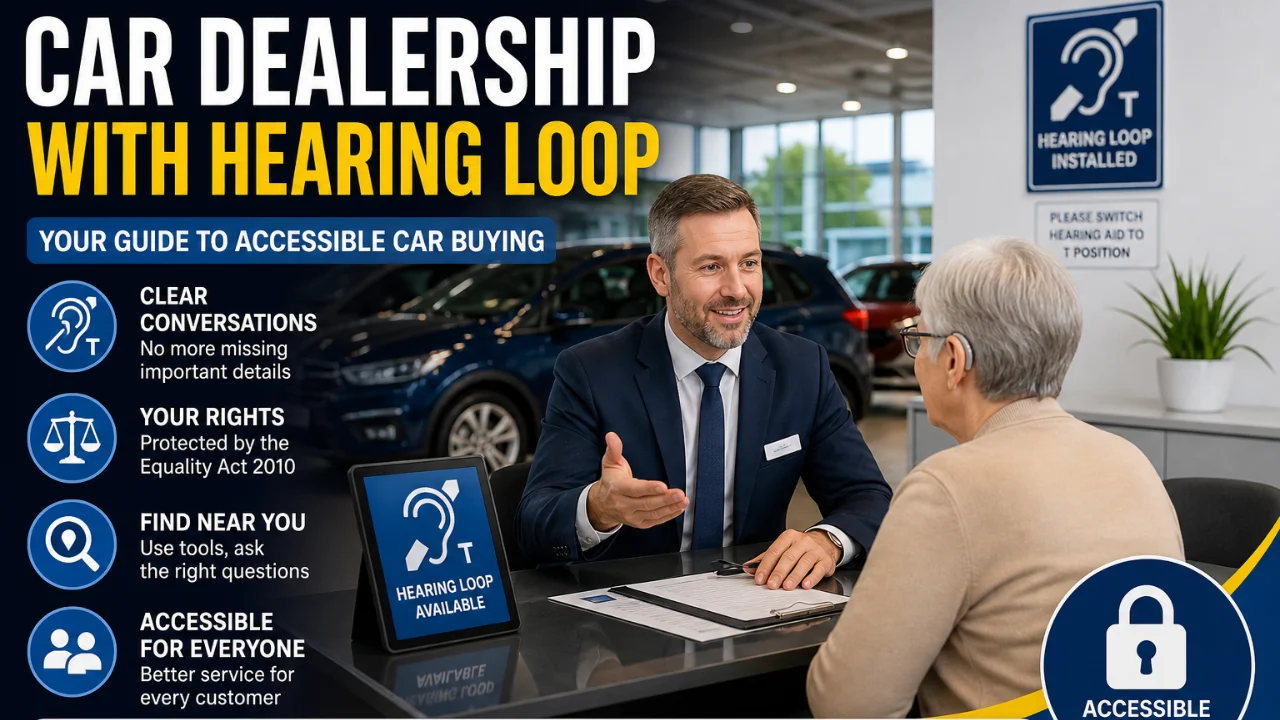
Picture this. You walk into a busy car showroom. There’s music playing, phones ringing, sales staff chatting, and the hum of traffic outside. For most people, it’s just background noise. For someone with hearing loss, it can make the entire experience genuinely exhausting — and stressful.
That’s a real problem. Around 18 million people in the UK now live with some degree of hearing loss, according to updated figures from RNID. That’s roughly one in three adults. Over half of people aged 50 and older experience hearing loss, and that figure climbs to 80% among those aged 70 and above.
These aren’t small numbers. These are car buyers. People who need clear, honest conversations about finance deals, warranty terms, and vehicle specs — details that genuinely matter.
A car dealership with hearing loop exists to fix this problem. This guide explains exactly what that means, how to find one near you, what the law says, and what to check before you visit.
What Is a Hearing Loop in a Car Dealership?
A hearing loop — also called an induction loop — is a sound system built for people who use hearing aids or cochlear implants.
It works by transmitting speech directly into the hearing device when switched to the correct setting. Instead of picking up every surrounding noise in the room, the listener receives a clearer version of the speaker’s voice.
Most hearing aids have a setting called the “T” position — short for telecoil. When you switch to this, the hearing aid tunes into the magnetic signal the loop produces, cutting out the echo and ambient noise that’s common in open-plan showrooms with hard floors and glass walls.
Hearing loops are ideal for improving accessibility in locations where one-to-one communication occurs — like reception desks, finance offices, and customer service points.
In a dealership setting, that’s exactly where the important conversations happen. Finance agreements, optional extras, service plans, handover paperwork — you need to hear every word clearly.
Why Car Showrooms Are Particularly Challenging
Not all environments are equal when it comes to sound. Showrooms are often filled with movement, engines, chatter, and echoing surfaces. Large open spaces with high ceilings bounce sound around in ways that are genuinely difficult for hearing aid users to manage.
It’s not just uncomfortable — it can lead to real misunderstandings. Missing a detail on a finance contract or misunderstanding a service agreement isn’t a minor inconvenience. It can cost money.
A hearing loop removes that barrier entirely. When it’s working properly, it gives customers with hearing loss the same quality of communication as anyone else in that room. No lip-reading required. No asking people to repeat themselves five times. Just a clear conversation.
Is a Hearing Loop a Legal Requirement for UK Car Dealerships?
The short answer: yes, in most cases.
The Equality Act 2010 requires businesses to provide “auxiliary aids and services” for customers who cannot hear. For many, this means installing a fully functional induction loop system.
The Act specifically states: “Service providers are required to make changes, where needed, to improve service for disabled customers or potential customers — including the provision of an induction loop for customers with hearing aids.”
The UK building standard BS 8300, updated in 2018, provides detailed guidance on hearing loop installation. It specifies that any reception point should be fitted with a hearing enhancement system, and that service or reception counters in noisy environments must have at least one position with assistive listening.
Part M of the Building Regulations also makes specific mention of service and reception counters as locations where induction loops should be installed.
In plain terms: if a dealership has a reception desk or a sales counter — and all of them do — they should have a hearing loop available.
That said, enforcement isn’t automatic. Many smaller independent dealers lag behind main franchise sites. So it’s always worth checking before you visit.
How to Find a Car Dealership with Hearing Loop Near You
Here’s where most people get stuck. There’s no single national directory that lists every accessible dealership in the UK. But there are reliable ways to track one down.
Use the Motability Scheme Dealer Locator
If you receive the Motability Allowance, the Motability scheme’s own dealer search tool lets you filter results by specific accessibility features. This is one of the most effective tools available, and major manufacturer sites for brands like Ford, Volkswagen, and MG also include an accessibility or facilities tab within their dealer finders.
Contact the Dealership Directly
Don’t assume. Call ahead and ask these specific questions:
- Do you have an induction loop at your sales desks and service counter?
- Is your hearing loop currently tested and working?
- Are your staff trained to assist customers who use hearing aids?
That third question matters. A system that exists but nobody knows how to use has limited value. A genuinely accessible dealership will have staff who can switch the loop on, check it’s functioning, and guide you to use the T setting without making it awkward.
Stick to Main Franchise Dealers
Main franchise dealerships are significantly more likely to maintain functional hearing loops than smaller independent lots. Brands like Arnold Clark, Sytner, and Vertu Motors operate across many UK sites and generally take accessibility requirements seriously due to the size of their operations and the need to maintain manufacturer accreditation.
Look for the Loop Symbol
The standard symbol for a hearing loop is a simple outline of an ear with the letter “T” next to it. This should be displayed clearly at any counter where a loop is in operation. If you walk into a showroom and don’t see this sign anywhere, ask.
What a Good Accessible Dealership Actually Looks Like
Finding a loop is the first step. But a genuinely hearing-accessible dealership goes further than a single piece of equipment.
Here’s what to look for when you arrive:
Clear signage at every counter. Look for signs showing where hearing loops are available, especially at reception, sales desks, and service counters.
A quiet consultation space. Open-plan showrooms are the hardest environment for hearing aid users. The best dealerships will offer a quieter private room where you can go through finance options and paperwork without competing against showroom noise.
Written quotations as standard. Any good dealership should give you everything in writing — price breakdowns, finance terms, monthly costs, and any optional extras. This isn’t just good for hearing loss; it’s good practice for every customer.
Patient staff. This costs nothing. Staff who speak clearly, face you directly, and don’t rush through explanations make an enormous difference.
Accessible parking and step-free entry. Hearing loss is sometimes part of a broader picture. Accessible facilities across the board signal that a dealership has genuinely thought about its customers.
The Business Case for Dealerships Installing Hearing Loops
It’s worth briefly noting this from a dealership’s perspective too — because it might help you when making the case to a dealer who seems reluctant.
People with hearing loss are estimated to be worth up to £4 billion in annual custom to UK businesses. That’s not a small figure. Any dealership that makes itself genuinely accessible is opening its doors to a large, underserved customer group.
A service counter hearing loop typically costs around £250 to £400 installed — and the installation is usually quick and undisruptive. For a business turning over millions annually, that’s a negligible investment. It also protects the dealership from potential legal challenges under the Equality Act.
Quick Comparison: What to Check at Any Dealership
| Feature | What to Ask | Why It Matters |
|---|---|---|
| Induction loop | Is it installed and working? | Core accessibility need |
| Loop signage | Is the T symbol displayed? | Legal requirement |
| Staff training | Do staff know how to use it? | Makes the system actually useful |
| Quiet room | Available for paperwork? | Reduces showroom noise issues |
| Written quotes | Do they provide these? | Ensures no missed details |
| Accessible parking | Clearly marked near entrance? | Practical visit comfort |
Your Rights as a Customer with Hearing Loss
Know your rights before you visit.
Under the Equality Act 2010, you are protected from being treated less favourably because of hearing loss. The law defines assistive listening systems as “reasonable adjustments” — meaning businesses must provide them where not doing so would put a hearing aid user at a substantial disadvantage compared to other customers.
If a dealership refuses to assist you, or has a hearing loop that is permanently out of service and never maintained, that could constitute a failure to make reasonable adjustments.
On the driving side, things are more straightforward. You do not need to inform the DVLA of a hearing loss diagnosis for a standard car or motorcycle licence. You can buy and drive a car like anyone else.
Under the Equality Act, insurers should not use a hearing loss diagnosis as grounds to increase your premium either. If an insurer tries to do this, you have grounds to challenge it.
Tips for Getting the Most from Your Dealership Visit
A few practical things that can genuinely help:
Call ahead and confirm the loop is working. Systems do break down. A quick call the day before saves a wasted journey.
Bring someone with you if you want to. There’s no rule against it. Having a companion for the contract and finance stages gives you an extra set of ears on important details.
Ask for everything in writing, twice. Monthly payment, total cost of finance, warranty terms, delivery date. All of it. A reputable dealer will have no problem with this.
Take your time. You are spending thousands of pounds. No decent sales person should rush you. If they do, that tells you something.
Check the loop yourself. Switch your hearing aid to the T setting at the counter and check the sound quality. A good loop should make the sales advisor’s voice come through clearly, with the background noise largely removed.
Conclusion
Buying a car is one of the bigger financial decisions most people make. Everyone deserves to go through that process with full information, clear communication, and no unnecessary barriers.
A car dealership with hearing loop is not a bonus feature — for millions of UK customers, it’s a basic requirement. The law supports this. The technology is affordable and widely available. There’s no good reason for any franchise dealership to be without one.
Before your next visit, use the Motability dealer finder, call ahead to confirm the loop is functional, and look for the T symbol when you arrive. If something doesn’t feel right, you have the right to ask for better.
You’re the customer. You’re spending the money. Make sure you hear every word of the deal.
FAQs About Car dealership with hearing loop
Q1. What is car dealership with hearing loop?
An induction system that sends clear speech directly to hearing aids using the T (telecoil) setting.
Q2. Are UK car dealerships required to have a hearing loop?
They must make reasonable adjustments under the Equality Act 2010, and hearing loops are commonly expected.
Q3. How can I find a dealership with a hearing loop?
Check the Motability Scheme locator, manufacturer websites, or call the dealership before visiting.
Q4. What if a hearing loop isn’t working?
Ask staff to fix it or provide an alternative, and raise a complaint if needed.
Q5. Does hearing loss affect buying or driving a car in the UK?
No, it doesn’t restrict buying or driving, and it shouldn’t affect insurance.
Q6. What accessibility features should I look for?
Look for quiet areas, written quotes, step-free access, accessible parking, and trained staff.
