
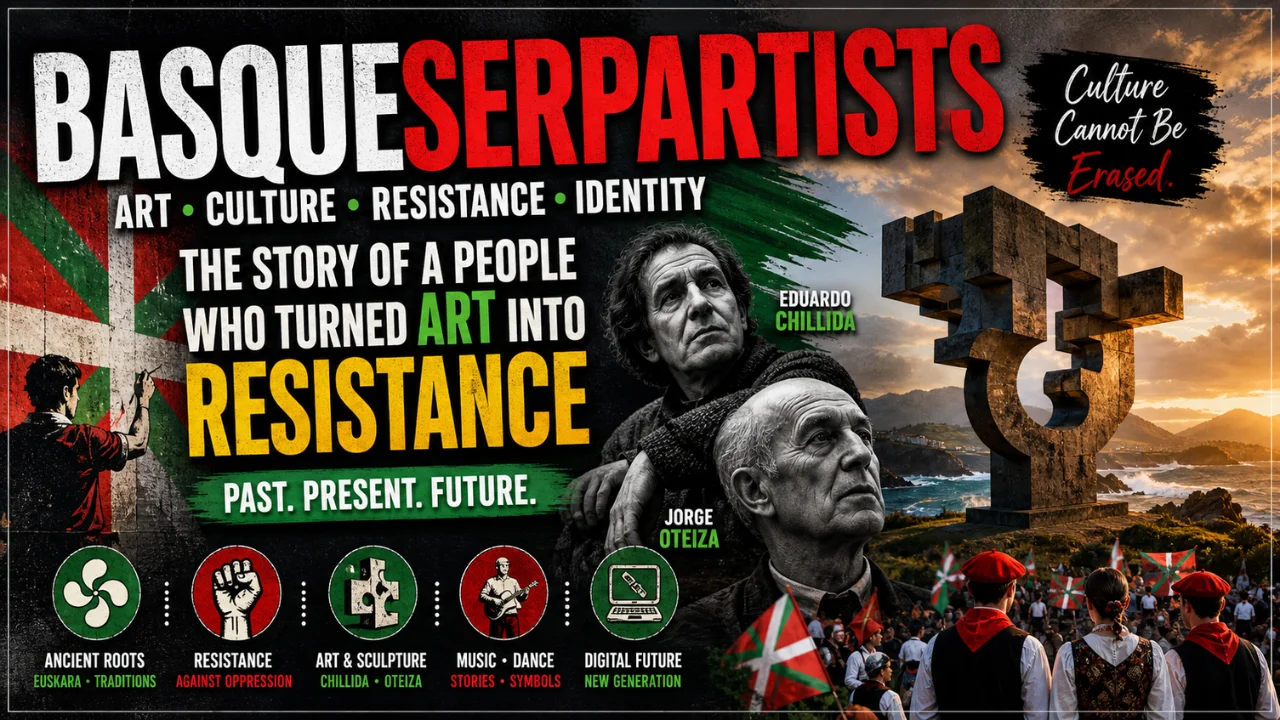
You might have seen the word “Basqueserpartists” and wondered — what does that even mean? Is it a typo? A new art movement? A political term?
The answer is actually all three, mixed together.
Basqueserpartists is a term that brings together two powerful ideas — Basque separatists and Basque artists. It represents the people of the Basque Country who refused to let their culture die. They used art, sculpture, music, dance, and storytelling to keep their identity alive — especially during decades when outside forces were actively trying to erase it.
This article breaks it all down. Who are these artists? What did they create? And why does it still matter today?
What Is the Basque Country?
Before talking about Basqueserpartists, you need to know a little about where they come from.
The Basque people live mainly in northern Spain and southwestern France, in a region known as the Basque Country. They have one of Europe’s oldest languages, called Euskara, which is not related to any other known language in the world. Their identity is built on strong traditions, music, folklore, and independence.
That last part — independence — is the key. The Basques have always felt different from Spain and France. Not just culturally, but historically. Their language predates the Roman Empire. Their customs, their food, their dances — they are entirely their own.
San Sebastian boasts more Michelin stars per capita than virtually any other city in the world. That tells you something about how seriously Basques take their culture. Everything they do, they do with intention.
What Does “Basqueserpartists” Really Mean?
The word is a mashup. It’s shorthand for a mix of things: Basque separatists, Basque artists, and Basque activists — people who lived in a part of Europe that has always felt a little apart from Spain, a little apart from France, and who refused to let their culture get swallowed.
Think of it this way. During the worst periods of political repression, the Basques did not just pick up weapons or write political pamphlets. Many of them picked up paintbrushes, chisels, and guitars instead. They encoded their identity into their art.
The term “Basque separatists” has no single clean definition because the thing it describes resists clean definition. It encompasses artists, cultural guardians, political activists, sculptors, poets, musicians, and street muralists. What connects them is not ideology or medium — it is a shared commitment to preserving something that the 20th century tried repeatedly to erase.
That is the heart of it. Not violence. Not one political view. Just survival through creativity.
The History Behind the Movement
When Culture Became Dangerous
To understand why Basqueserpartists exist, you have to understand what happened in Spain during the 20th century.
Franco’s Spain from 1939 to 1975 banned Euskara in schools and public life. Imagine being told your own mother tongue was illegal. That your songs, your myths, your name for your hometown — all of it suddenly had to be hidden.
During this time, murals, cryptic symbols, folk songs, and experimental performances became tools of cultural resistance and preservation.
Artists could not simply say what they believed. So they showed it — in abstract shapes, in hidden symbols, in sculptures that looked like they were just about space and matter but were really about freedom and identity.
The GAUR Group — A Turning Point
One of the most important moments in this history happened in 1966.
In 1966, the Gaur group was formed in Gipuzkoa with the aim of reviving Basque culture and identity amidst the suffocating repression of the Franco dictatorship. Gaur, which means ‘today’ in Basque, was made up of Jorge Oteiza, Eduardo Chillida, Remigio Mendiburu, José Antonio Sistiaga, José Luis Zumeta, Amable Arias, and Néstor Basterretxea. Its aim was to define the Basque School of Contemporary Art.
Although the groups did not last over time due to disputes among the artists, they established the foundations for protest art and identity art that expressed a Basque ‘soul’ through new contemporary avant-garde languages.
That is a big deal. These artists were essentially building the blueprint for how culture survives oppression. Their work became a template for generations that came after.
The Most Iconic Basqueserpartist Artists
Eduardo Chillida — Sculptor of Freedom
Eduardo Chillida Juantegui (10 January 1924 – 19 August 2002) was a Spanish Basque sculptor notable for his abstract works, born in San Sebastián.
What made Chillida special was not just technical skill. It was his philosophy. Much of Chillida’s work is inspired by his Basque upbringing, and many of his sculptures’ titles are in the Basque language Euskera.
His sculptures are massive but they feel alive. They suggest tension, movement, and breath. His works, although massive and monumental, suggest movement and tension. You look at them and feel something without quite knowing why.
In the early 1980s, Chillida and his wife bought a sixteenth century Basque farmhouse and surrounding land at Hernani near San Sebastián to establish a permanent place to display his work in a natural environment. This opened in the 1990s as Chillida Leku, an open-air museum where visitors could wander among the sculptures.
Jorge Oteiza — The Philosopher-Artist
Where Chillida was about presence, Oteiza was about absence.
Jorge Oteiza worked differently — where Chillida built outward into mass and presence, Oteiza explored emptiness and negative space. His sculptures are often defined by what has been removed rather than what remains. He believed that the experience of void was the closest art could come to expressing the deepest states of being.
That is a radical idea. Most artists add to the world. Oteiza subtracted — and found meaning in that subtraction. His theoretical writing was just as powerful as his physical work.
It would be impossible to understand Basque art without considering the vital legacy of Jorge Oteiza and Eduardo Chillida. The two sculptors had enormous influence on several generations of Basque artists, including Txomin Badiola, Cristina Iglesias, Peio Irazu, and Ángel Bados.
Other Key Figures Worth Knowing
The movement was never just two people. Key figures in the Basqueserpartists movement include Agustín Ibarrola, known for large-scale installations that merge ecological themes with Basque identity; María José Aranguren, celebrated for her use of traditional mediums; Xabier Montfort, a performance artist who explores identity politics; and Nika Mendiola, recognized for her digital art installations that reinterpret Basque symbols in modern contexts.
Esther Ferrer is a pioneer and leading representative of performance art. The Basque Country also boasts numerous art museums and cultural centres, including the Guggenheim Bilbao Museum, Bilbao Fine Arts Museum, Artium Museoa, and Tabakalera.
The Symbols They Use
Basqueserpartist art is full of symbols that carry deep meaning. If you know what to look for, a painting or a sculpture suddenly tells a whole story.
The Serpent (Herensuge): In Basque tradition, the serpent or Herensuge is not evil like in some Western myths. Instead, it’s a symbol of strength, knowledge, and transformation. Basqueserpartists use serpent shapes to represent the constant change in their society.
Mountains and the Sea: The mountains, the Bay of Biscay, the forests — these are not backdrops in Basque cultural memory. They are characters. They appear in mythology, in folklore, in song, and in the work of artists who grew up understanding that identity is not just about language and history but about the specific relationship between a people and the land.
Spirals and Geometric Forms: These represent time, continuity, and the cycles of Basque life. You find them in ancient stone carvings as much as in modern digital art.
Art as Political Resistance
One of the most interesting chapters in Basqueserpartist history involves visual propaganda — and it is more sophisticated than the word “propaganda” usually suggests.
During the decade between the establishment of Spanish democracy in 1978 and the fall of the Berlin Wall in 1989, when separatist sentiment reached a peak in the Basque Country, sticker-based visual art became a useful index of political currents — and an interesting analogue prototype of what we might call, in the 21st century, meme culture.
Artists were essentially doing in the 1970s and 80s what internet creators do today — spreading ideas visually, quickly, and across mass audiences. They remixed famous artworks, added local slogans, and circulated the results in bars and public spaces.
This was not just decoration. Their artistic practices became a method of resistance and opened a void, reflecting the opposing facets of Basque identity.
From Underground to Global Stages
After democracy returned to Spain in 1975, Basque artists did not disappear. They grew louder.
The artists who began working in the 1990s, trained at the Arteleku production centre in Donostia, brought various innovations to the table. With New York as a point of reference, the dissolution of traditional disciplines, along with identity, the body, and social and political issues, became subjects of debate for a generation in which women gained increasing visibility.
The Basque Artist Program, a joint initiative of the Guggenheim Museum Bilbao and the Solomon R. Guggenheim Museum, New York, launched in 2015, and open to artists born or resident in the Basque Country, selects two persons each year to take part in an intensive orientation of the New York art scene.
That is how far things have come. From underground resistance art to being featured at the Guggenheim in New York.
Basqueserpartists Today — The Digital Generation
The movement has not stopped. It has simply changed shape.
Many young Basque creators now use digital tools, social media, and NFTs to share their work globally. They create music videos, animations, and AI art that carry the same cultural DNA as their ancestors’ carvings and dances. This new generation mixes old Basque patterns with futuristic designs.
Filmmakers now produce content in Euskara, while young creators share traditions through social media. Basque cuisine has gained global recognition, especially in cities like San Sebastián. Music blends tradition with modern styles.
The tools change. The mission does not. Keep Basque culture alive. Make it visible. Share it with the world.
Why This Movement Matters Beyond the Basque Country
You might be wondering — why should someone outside the Basque Country care about any of this?
Here is why. The Basqueserpartists story is really a universal story. It is about what happens when a group of people refuses to disappear. It is about using creativity as a form of survival. It is about how culture, language, and art can outlast even the most brutal suppression.
The sculptures Chillida and Oteiza built in the 20th century are still standing. The language they fought to preserve is still spoken — and by more young people than at any point since Franco’s suppression. The stories encoded in the serpent symbols of ancient mythology are still being told in new media by artists born decades after the worst of the repression ended.
That continuity is the point. They did not just survive — they thrived.
A Quick Guide: Understanding Basqueserpartist Art
If you want to actually look at this art and understand what you’re seeing, here is a simple guide:
What to look for:
- Abstract shapes that feel emotional, not decorative
- Nature symbols — mountains, oceans, serpents
- Negative space (especially in Oteiza’s work)
- Titles in Euskara (the Basque language)
- Large-scale public installations
Where to find it:
- Guggenheim Museum Bilbao
- Chillida Leku (open-air museum near San Sebastián, reopened 2019)
- Artium Museoa in Vitoria-Gasteiz
- Bilbao Fine Arts Museum
- Instagram accounts of young Basque digital artists
What it usually communicates:
- Identity and belonging
- Resistance without violence
- Connection to land and language
- Survival across generations
Conclusion
Basqueserpartists are not a relic of history. They are an ongoing conversation between the past and the present.
These artists — from Chillida’s massive iron sculptures to today’s digital creators sharing Basque myths on social media — have one thing in common. They believe that culture is worth protecting. That language is worth speaking. That identity is worth expressing, even when it is inconvenient or dangerous.
If you are curious about art that carries real weight — not just aesthetic beauty but historical memory — Basque art is worth your time. Start with Chillida and Oteiza. Then find the young creators building on that legacy today.
The Basqueserpartists have always been here. Now the world is finally paying attention.
FAQs About Basqueserpartists
What does “Basqueserpartists” mean?
A combined term for Basque separatists and artists preserving identity through culture.
Who are the most famous Basqueserpartist artists?
Eduardo Chillida and Jorge Oteiza are most recognized; others include Agustín Ibarrola and Esther Ferrer.
What is the Basque language called?
Euskara — one of Europe’s oldest and unique languages.
Where can I see Basque art?
Guggenheim Museum Bilbao, Chillida Leku, Artium Museoa, and Bilbao Fine Arts Museum.
Is the Basqueserpartist movement still active?
Yes, modern artists continue it through digital art, music, and film.
What symbols are common in Basqueserpartist art?
Serpent (Herensuge), mountains, waves, spirals, and geometric forms.
