
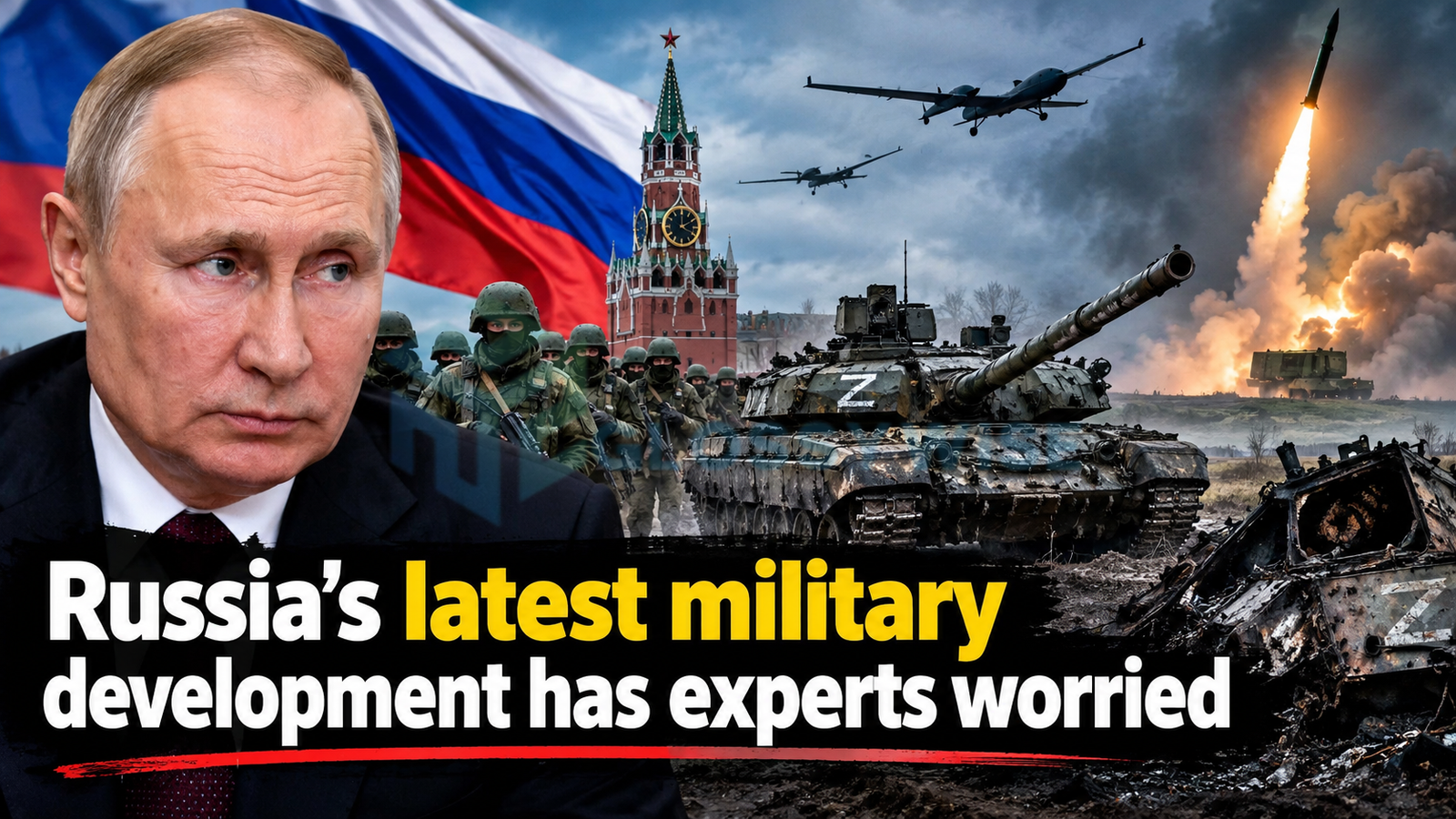
Russia’s military position has become increasingly complicated after more than four years of full-scale war in Ukraine. Moscow still possesses one of the world’s largest armed forces, a huge missile and drone arsenal, substantial artillery capacity and the ability to recruit new personnel. However, the prolonged conflict has also created serious costs in manpower, equipment, finances and military readiness.
Recent assessments suggest that Russia has not simply run out of military power. Instead, the more important question is how efficiently Moscow can replace its losses while maintaining pressure on the battlefield. Russia has continued expanding the authorized size of its armed forces, with a July 2026 decree setting the authorized strength at more than 2.42 million personnel, including 1.535 million military personnel.
At the same time, independent assessments have highlighted the enormous human and equipment costs of the war. A CSIS assessment published in July estimated around 1.4 million Russian battlefield casualties, including as many as 450,000 deaths, although wartime casualty estimates remain uncertain.
This combination of continued recruitment, battlefield losses, and increasingly sophisticated Ukrainian drone attacks is one reason experts are watching Russia’s military development so closely.
Why Russia’s military development is attracting attention
The biggest concern is not necessarily that Russia has suddenly become militarily weak. It is that the Russian military’s character is changing after years of sustained combat. Russia has increasingly relied on drones, precision weapons, electronic warfare, artillery, glide bombs and large-scale missile attacks. Ukraine, meanwhile, has developed increasingly capable long-range drone operations against Russian military, industrial and energy targets. The result is a conflict in which traditional measurements such as the number of tanks or soldiers do not tell the whole story.
Russia can replace some equipment and personnel, but replacing experienced soldiers, commanders, and sophisticated military hardware is considerably more difficult. The same applies to modern tanks and armored vehicles that require training, crews, maintenance, and logistical support.
Recent battlefield assessments indicate that Russia continues to advance in parts of eastern Ukraine, but its progress has generally been slow and costly. Reuters reported in September 2026 that Russian forces were pushing toward important positions in Donetsk while Ukraine was preparing for intense fighting during the autumn.
Russia is still a major military power.
Despite its losses, it would be misleading to describe Russia as a military force that has simply collapsed. Russia remains capable of conducting large-scale missile and drone attacks, maintaining pressure along a long front and producing or acquiring significant quantities of military equipment. Its nuclear arsenal also remains a major part of its strategic power.
The more accurate description is that Russia’s conventional military has suffered substantial attrition while adapting to a long war. Its ability to continue fighting demonstrates that Moscow retains considerable military resources, even though those resources come at a much higher cost than before the invasion.
A major part of Russia’s strategy has therefore become the ability to sustain the war rather than achieving a quick battlefield victory.
How weak is Russia’s military right now?
Russia’s military is weaker in some important respects than it was before the full-scale invasion of Ukraine, but it is not powerless. The war has consumed enormous quantities of personnel and equipment. CSIS estimates that Russian battlefield casualties reached approximately 1.4 million by mid-2026, with up to 450,000 deaths.
However, Russia has also expanded the authorized size of its armed forces. In July 2026, the authorized total strength reached 2,426,130 personnel, including 1,535,000 military personnel. This creates a complicated picture. Russia has suffered serious losses, but it has also been able to recruit, reorganize and expand its force structure.
The key weakness is therefore not simply the number of soldiers available. It is the difficulty of maintaining highly trained manpower, modern equipment and sustainable logistics while fighting a long and technologically demanding war. Russia’s battlefield performance also varies considerably by sector. In some areas it has been able to maintain pressure and make territorial gains, while in others Ukrainian defenses and drone operations have slowed Russian advances.
How many T-90 tanks has Russia lost?
There is no single universally accepted number for Russian T-90 losses.
The reason is that Russia does not publish a comprehensive, independently verifiable battlefield inventory of every tank lost in Ukraine. Open-source tracking projects count only losses that can be visually or otherwise independently documented, meaning their totals should be treated as minimum confirmed losses rather than a complete accounting.
T-90s are among Russia’s most modern main battle tanks and have been used extensively during the war. Losing these vehicles is significant because advanced tanks require trained crews, spare parts, maintenance infrastructure, and considerable resources to replace. It is also important to distinguish between a tank being destroyed, damaged, abandoned, or captured. Different databases may classify these categories differently, which explains why figures can vary between sources.
More broadly, Russia has suffered extensive armored-vehicle losses during the war. A recent assessment cited by AP put Russian military equipment losses at more than 10,000 armored vehicles alongside very large personnel losses. Therefore, claims about a precise number of T-90 tanks lost should be treated cautiously unless they are tied to a clearly defined database and methodology.
Russia’s manpower problem is bigger than the headline number.s
One of the most important challenges facing Moscow is replacing combat losses without triggering politically difficult mobilization measures. Russia has continued using financial incentives and military contracts to attract personnel. Reuters reported in September 2026 that contract soldiers receive a minimum one-time payment of 400,000 rubles, with regional incentives potentially making the total substantially higher.
Ukraine’s military intelligence chief has recently argued that Russia’s recruitment rate may be insufficient to offset battlefield losses. Such estimates are claims from Ukrainian intelligence and should not be treated as independent facts, but they illustrate the central manpower debate surrounding Russia’s war effort. The problem becomes more serious when experienced personnel are considered. A newly recruited soldier is not equivalent to an experienced combat veteran, tank commander, engineer, or specialist.
That distinction can have a major effect on military effectiveness even when the overall number of personnel remains high.
How much of Russia’s army is left?
There is no reliable public figure showing exactly how much of Russia’s original army is “left.”
This is because Russia has continuously recruited new personnel, expanded its authorized force size, reorganized formations, and brought additional resources into the war. It therefore cannot be calculated simply by subtracting reported casualties from the pre-war army. The July 2026 authorized figure of 1.535 million military personnel is particularly important, but it represents authorized strength rather than a guarantee that every position is filled and operationally ready. In other words, Russia still has a very large military establishment. The harder question is how many personnel are combat-ready, how many are deployed, how many are in training, and how many are assigned to support and other duties.
This distinction is essential when evaluating claims that Russia has only a certain percentage of its army remaining.
What percent of Russia supports Putin?
Public support for Vladimir Putin remains substantial, but polling numbers vary depending on the organization, question, and timing.
A July 2026 assessment citing Russian and independent polling showed that Putin’s approval had declined during June. VTsIOM reported an approval figure of 66.9%, while the independent Levada Center reported approval of 74% for June, down from 79% previously.
These figures demonstrate why it is better to avoid saying that one exact percentage represents all Russians.
Approval of a president also does not necessarily mean that every person who approves of Putin supports every military decision or wants the war to continue indefinitely.
More recent reporting has shown increasing public anxiety about the war. Reuters reported in September 2026 that anxiety among Russians had remained elevated, with concerns including Ukrainian drone attacks and the possibility of another mobilization.
Why Russia can still fight despite enormous losses
Russia’s continued military capacity comes from several advantages.
The country has a large population, a major industrial base, substantial natural resources, and an established defense industry. It has also adapted its military economy to sustain weapons production and recruitment.
Russia has increasingly emphasized relatively inexpensive drones alongside missiles, artillery, and other weapons. This allows Moscow to put pressure on Ukraine without relying exclusively on expensive conventional platforms. At the same time, Russia has received military cooperation and equipment from foreign partners, while Ukraine has depended heavily on Western military assistance. The war has therefore become a contest of industrial capacity, technology, manpower and political endurance as much as a traditional battlefield conflict.
The growing importance of drones and long-range warfare
One of the clearest changes in the war has been the growing importance of unmanned systems.
Ukraine has repeatedly used long-range drones to attack targets deep inside Russia, including energy infrastructure, logistics facilities, and military-related sites. Russia has responded with its own large-scale drone and missile campaigns against Ukrainian cities and infrastructure.
This development makes traditional military strength comparisons increasingly difficult.
A country may have thousands of tanks but still face serious problems if its supply lines, command posts, fuel facilities,s and air-defense systems are vulnerable to inexpensive drones.
The same is true for Russia. Its large conventional arsenal remains important, but the ability to protect military infrastructure against increasingly sophisticated drone attacks is becoming a major measure of modern military effectiveness.
Russia’s military future could depend on sustainability
The most important question is no longer simply whether Russia has enough weapons or soldiers for another offensive.
It is whether Russia can maintain its current level of military activity for years while replacing casualties, repairing equipment and sustaining the economy.
CSIS has described the cost of the war as increasingly significant for Russia, while noting that Ukrainian long-range strike capabilities have become more effective.
At the same time, Russia has demonstrated significant resilience.
That combination explains why experts continue to watch the conflict closely. Russia is taking serious losses, but it has also shown an ability to absorb those losses and continue military operations.
What Russia’s military situation means for the Ukraine war
Russia’s military condition will directly influence the future of the war.
If Moscow can continue recruiting enough personnel and producing weapons, it can maintain pressure on Ukraine even without rapid territorial gains. If losses become increasingly difficult to replace, however, the Kremlin could face harder choices about mobilization, military spending,g and battlefield objectives.
Ukraine faces its own manpower and equipment challenges, meaning Russia’s difficulties do not automatically translate into a Ukrainian victory.
The current situation is better understood as a long-term contest of endurance.
Recent reporting indicates that the front remains active and that Russian forces continue trying to make progress in Donetsk, while Ukraine is relying heavily on defensive positions, drones and long-range strikes.
Why experts remain worried about Russia’s military development
The concern surrounding Russia is therefore not simply that the country is becoming stronger or weaker.
It is that Russia is adapting to a new type of warfare.
The Russian military has experienced extraordinary losses since 2022, yet Moscow continues to recruit personnel, expand its force structure, manufacture weapons and conduct large-scale operations.
At the same time, Ukraine’s growing ability to strike targets far behind the front has created new vulnerabilities for Russia.
That combination makes the Russian military difficult to assess using traditional statistics alone.
##Frequently Asked Questions
Is Russia’s military still powerful?
Yes. Russia remains one of the world’s major military powers, with a large armed force, extensive missile and drone capabilities, a major defense industry, and a large nuclear arsenal. However, its conventional forces have suffered substantial losses during the war in Ukraine.
Has Russia lost most of its tanks?
Russia has lost a very large number of armored vehicles, but there is no universally accepted figure showing that it has lost a specific percentage of all its tanks. Open-source databases generally record only visually confirmed losses, meaning actual losses can be higher.
Is Russia running out of soldiers?
Russia faces a significant manpower challenge, but it has continued recruiting personnel and increasing the authorized size of its armed forces. The exact number of combat-ready troops is not publicly known.
Does most of Russia support Putin?
Polling indicates that Putin continues to have substantial approval inside Russia, although the exact figure varies considerably by pollster and period. Recent polling has also shown increased anxiety about the war and possible mobilization.
How many Russian soldiers have been killed?
There is no independently verified final figure. CSIS estimated up to 450,000 Russian military deaths by mid-2026, while other assessments have produced different numbers. Wartime casualty estimates should therefore be treated as estimates rather than exact counts.
Is Russia getting weaker because of the Ukraine war?
Russia has suffered major personnel and equipment losses, but it has also adapted its military production and recruitment systems. Its conventional military has been heavily strained, yet Russia retains considerable capacity to continue fighting.
Could Russia still win the war in Ukraine?
The outcome remains uncertain. Russia retains substantial military resources, while Ukraine continues to resist and has developed increasingly effective drone and long-range strike capabilities. The eventual outcome will depend on military, economic, political, and diplomatic developments.
Conclusion
Russia’s latest military situation presents a complicated picture. The country has suffered enormous battlefield losses, including large numbers of personnel and armored vehicles, but it has not lost the ability to wage war. Instead, Russia has adapted by increasing recruitment, expanding its authorized military structure, relying heavily on drones and missiles, and maintaining pressure on Ukrainian positions. The most important issue going forward will be sustainability. Russia’s ability to replace personnel and equipment while maintaining its military-industrial base could be more important than any single tank-loss figure. For that reason, claims that Russia’s army is either completely defeated or overwhelmingly dominant oversimplify a much more complicated reality. The evidence points to a military that has been severely tested and heavily depleted in some areas, but that still possesses substantial resources and the ability to continue fighting.
