
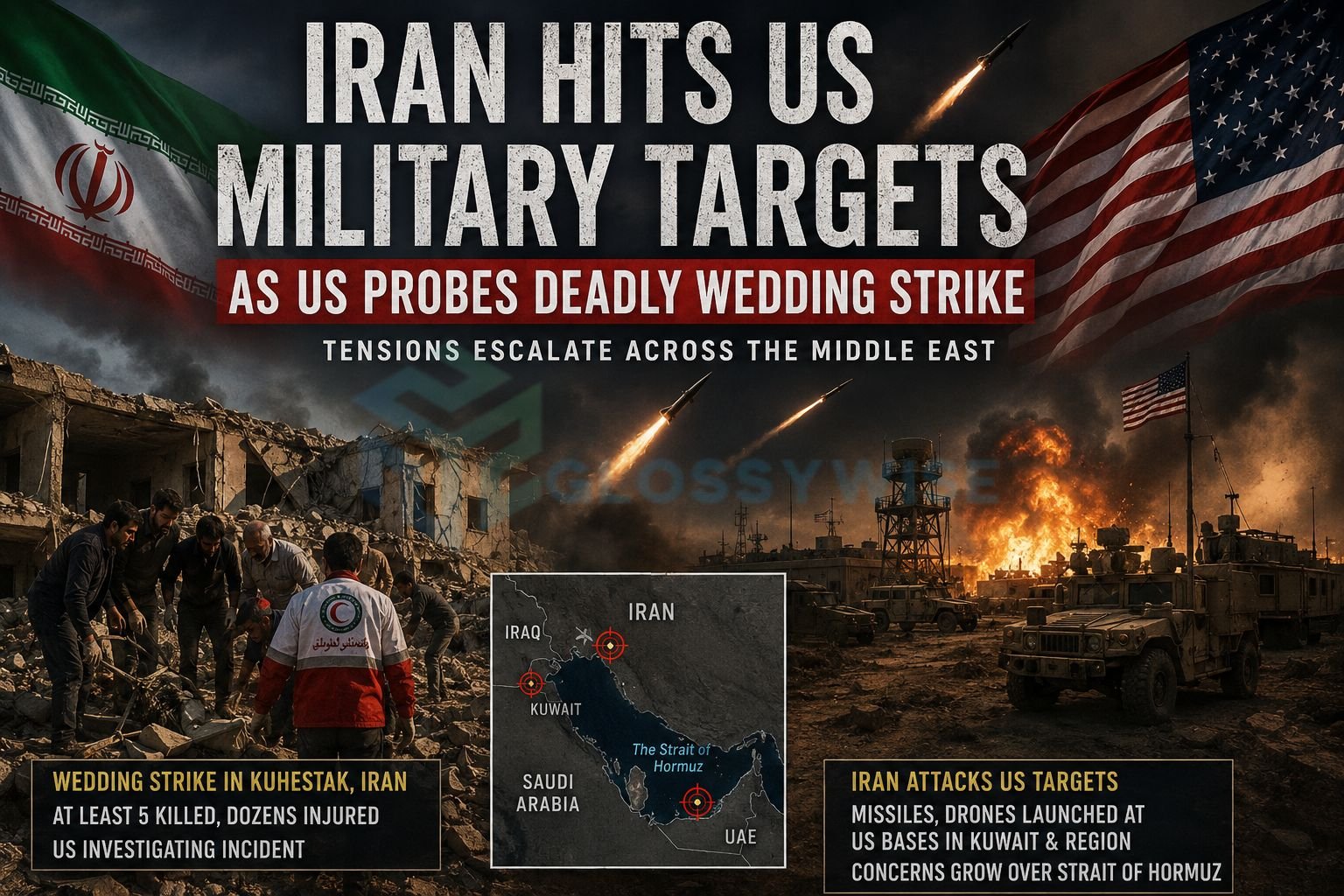
Iran Hits US Military Targets as Washington Investigates Wedding Strike
Tensions between Iran and the United States have sharply escalated after Iran launched missile and drone attacks against US military positions in the Middle East, while Washington investigates a deadly strike that hit a residential property where a wedding gathering was taking place in southern Iran.
The developments mark one of the most serious escalations in the US-Iran confrontation in more than a month. The latest exchange of attacks has raised fresh concerns about civilian casualties, the safety of US personnel and regional allies, commercial shipping through the Strait of Hormuz, and the potential for further disruption to global energy markets.
The wedding strike occurred on September 1, 2026, in Kuhestak, a coastal town in Sirik County in Iran’s Hormozgan province. Iranian authorities and humanitarian officials reported that civilians were killed and dozens more were injured.
A Reuters investigation published September 3 found that weapons experts examining verified photographs and videos believed the explosion was likely caused by a direct hit from a US munition. The analysis suggested the weapon may have been a 500-pound air-dropped bomb. US officials, however, have emphasized that American forces do not deliberately target civilians and that the circumstances surrounding the incident are being investigated.
The incident has become a major focus of international attention because the reported civilian deaths came during a broader US military campaign targeting Iranian military infrastructure near the strategically important Strait of Hormuz.
What Happened in the Iranian Wedding Strike?
The reported wedding strike took place on the evening of September 1 in Kuhestak, a small coastal community in southern Iran.
According to Iranian officials and reports from humanitarian organizations, a residential building where a wedding celebration was being held was struck during a series of US attacks in the area.
The Iranian Red Crescent reported that at least five people were killed and about 67 others were injured. Earlier reports had put the death toll at four, meaning the figures changed as authorities gathered more information about the casualties.
Among those reported killed was a young child.
The attack reportedly destroyed part of the house and caused significant damage to nearby structures. Videos and photographs from the location showed debris, damaged buildings and the remains of the wedding gathering.
The tragedy occurred while family members and guests were gathering for the celebration. Reports described a community event that quickly turned into a mass-casualty incident.
The location is particularly significant because Kuhestak lies close to the Strait of Hormuz, one of the world’s most important maritime energy routes.
Weapons Analysis Points Toward a US Munition
One of the most important developments came from an analysis of photographs and videos from the strike site.
Reuters consulted weapons experts who examined verified visual material from Kuhestak. Their assessment indicated that the damage was more consistent with a direct hit from a US munition than with a missile that had ricocheted or otherwise caused secondary damage.
The experts suggested that the weapon could have been a 500-pound air-dropped bomb. Other analyses of remnants found at the location have also pointed toward US-made precision-guided weapons.
The exact weapon and circumstances remain subject to investigation.
That distinction is important. Identifying the likely origin of a munition does not by itself establish why the target was selected, whether the intended target was nearby, or whether the civilian casualties resulted from an identification, targeting or operational error.
Reports indicate that a telecommunications tower near the residential property was among the military-related infrastructure targeted in the area.
The Washington Post’s reporting placed the communications tower roughly 100 meters from the home where the wedding was taking place.
Reuters’ visual analysis placed the wedding location approximately 135 meters from a telecommunications tower that had been identified as a target.
That proximity is now central to questions about how the operation was planned and executed.
Why Was the United States Targeting the Area?
The US military’s broader operation was focused on Iranian military capabilities linked to the confrontation around the Strait of Hormuz.
US officials said the strikes targeted military infrastructure including air-defense systems, radar installations, communications facilities, maritime assets and mine-laying capabilities.
The operation came after months of tension over Iranian actions affecting commercial shipping in and around the Strait of Hormuz.
The waterway has become one of the central pressure points in the US-Iran confrontation because of its importance to global oil and gas transportation.
American officials have argued that military action is necessary to protect maritime traffic and prevent Iran from using mines, missiles, drones or other capabilities to threaten commercial shipping.
But military operations in coastal areas can create significant risks for nearby civilian communities.
That is why the Kuhestak incident is being closely examined by US officials and outside investigators.
Why Is Washington Investigating the Wedding Strike?
US Vice President JD Vance said Washington was investigating the incident.
The investigation is significant because the US government has repeatedly stated that American forces do not intentionally target civilians.
Vance emphasized that the United States needs to determine what happened and whether a mistake occurred during the operation. At the same time, he expressed skepticism about some Iranian claims surrounding the incident.
US Central Command has also acknowledged awareness of reports concerning the strike.
An investigation could examine several key questions:
- What was the intended US military target?
- Which weapon was used?
- How was the target identified?
- Was the residential building visible or known to be occupied?
- How close was the intended target to the wedding location?
- Did the weapon strike its intended target?
- Were civilian casualties anticipated?
- Were appropriate precautions taken before the attack?
- Was there an intelligence or targeting error?
- Did the weapon malfunction or deviate from its intended path?
These questions matter because the answer could influence both the military assessment of the incident and international criticism of the US campaign.
Iran Responds With Attacks on US Military Positions
Iran did not treat the wedding strike as an isolated incident.
Tehran responded with missile and drone attacks aimed at US military positions and facilities in the region.
Reuters reported that Iran launched attacks against US bases in Kuwait and other locations, including areas associated with the broader American military presence in the Middle East.
Iranian military statements also claimed attacks on facilities in Kuwait and the United Arab Emirates.
According to the Institute for the Study of War, Iran’s military said it targeted communications systems, equipment warehouses and fighter-aircraft hangars at Ahmad al-Jaber Air Base in Kuwait. It also said missiles and drones were directed at troop positions and radar installations at Al Minhad Air Base in the UAE.
The precise extent of damage from these Iranian attacks remains disputed.
This is an important distinction when reporting the conflict. Iran may claim that specific US facilities were successfully hit, while American or allied officials may dispute whether the weapons reached their intended targets or caused significant damage.
As a result, individual battlefield claims should be treated cautiously until independently verified.
Did Iran Attack the US Base?
Yes, Iran has claimed that it attacked US-linked military facilities in the region with missiles and drones. Reports have specifically mentioned US military positions in Kuwait and other locations where American forces operate.
Iranian statements said that targets included communications systems, equipment storage areas, aircraft hangars, troop positions and radar installations. These claims came after the United States carried out strikes against Iranian military infrastructure.
However, the exact level of damage remains disputed. Iran may describe an operation as successful, while US or allied officials may say that missiles were intercepted, missed their targets or caused limited damage.
The term “US base” can also refer to different types of facilities, including major air bases, logistics centers, communications sites and smaller military compounds. Some facilities may be operated by the United States, while others may be located in allied countries and support American operations.
For that reason, reports about an Iranian attack should be evaluated by checking the location, the intended target, the number of weapons launched and independent evidence of damage.
Why Kuwait Is Important to the US-Iran Conflict
Kuwait has become increasingly important because of its geographic position and its role in supporting US military operations in the region.
The country hosts US military forces and infrastructure, making it a potential target whenever Iran seeks to retaliate against American operations.
However, attacks on US-linked facilities in Kuwait create another layer of risk because Kuwait is not Iran’s direct battlefield opponent.
Any Iranian attack that lands inside Kuwait could be viewed as an attack on Kuwaiti territory and could increase pressure on the United States and other Gulf states to respond.
Kuwait has condemned Iranian attacks and activated defensive measures in response to missile and drone threats.
This illustrates how the Iran-US confrontation can quickly involve countries across the Gulf even when they are not directly participating in the initial exchange.
Is the US Going to War With Iran?
The United States and Iran are already involved in direct military confrontation if American forces have struck Iranian targets and Iran has retaliated against US military positions. However, that does not automatically mean that Washington has declared a full-scale war or that a long-term ground invasion is underway.
The risk of a wider war depends on the scale and frequency of future attacks. Limited airstrikes, missile exchanges and attacks on military facilities can remain contained, but repeated retaliation can create an escalation cycle that becomes difficult to control.
Several factors could determine what happens next:
- Whether Iran continues attacking US bases
- Whether the United States expands its target list
- Whether American personnel are killed
- Whether Gulf states are directly hit
- Whether commercial shipping is disrupted
- Whether diplomatic channels remain open
- Whether either side accepts a temporary ceasefire
A full-scale war would likely involve sustained military operations, broader mobilization and attacks across multiple fronts. At present, the most immediate concern is that a limited confrontation could expand through repeated retaliation and miscalculation.
The Strait of Hormuz Has Become the Central Flashpoint
The Strait of Hormuz is at the heart of the latest escalation.
The narrow waterway connects the Persian Gulf with the Gulf of Oman and the Arabian Sea. It is one of the world’s most important routes for transporting oil, natural gas and other energy products.
Before the current conflict, roughly one-fifth of global oil shipments moved through the Strait of Hormuz.
That makes any military confrontation around the waterway a global economic concern.
Even when oil supplies are not physically destroyed, fears about shipping disruption can cause energy traders to increase prices because they anticipate a higher risk premium.
The latest escalation has already pushed crude prices higher.
Reuters reported that Brent crude moved above $96 a barrel as renewed US-Iran tensions raised concerns about supplies and shipping through the region.
Iran’s Restrictions on Shipping Add to the Pressure
The military confrontation is occurring alongside growing restrictions on maritime traffic.
Iran has expanded a blacklist of vessels that it says are prohibited from passing through the Strait of Hormuz.
According to Reuters, the number of blacklisted vessels reached 56 after additional ships were added to the list. The affected vessels include crude oil tankers, LNG carriers, LPG carriers and clean-product vessels.
These restrictions are important because shipping companies make decisions based not only on whether a route is technically open but also on whether the route is safe, insurable and commercially viable.
A waterway can remain physically navigable while traffic falls sharply because shipowners fear attacks, mines, seizures or sanctions.
That is one reason the Strait of Hormuz remains a major concern for global markets.
What Does the Conflict Mean for Oil Prices?
Oil markets are particularly sensitive to developments in the Gulf.
When traders believe that crude supplies could be interrupted, prices can rise even before an actual shortage occurs.
Brent crude was trading near $96 a barrel on September 4, with the benchmark heading toward a strong weekly gain amid renewed US-Iran tensions.
The consequences can spread well beyond gasoline prices.
Higher oil prices can increase:
- Gasoline and diesel costs
- Airline fuel expenses
- Shipping costs
- Manufacturing expenses
- Electricity and heating costs
- Food transportation costs
- Consumer inflation
Asia is particularly exposed because it is heavily dependent on Middle Eastern energy supplies.
Reuters reported that Asian refined-fuel imports fell sharply in August, while prices for products such as gasoil increased substantially amid the wider disruption caused by the conflict.
This means the Iran-US confrontation is not simply a military story. It is also an economic story affecting businesses, governments and consumers around the world.
Is Iran Threatening the United States?
Yes, Iranian officials and military commanders have repeatedly warned that US forces and American interests could face retaliation if Washington continues attacking Iranian targets.
Iran’s threats have generally focused on US military bases, naval forces, regional allies and other American-linked facilities. Tehran has also warned that any attack on Iranian territory could produce a wider response across the Middle East.
Iran’s ability to carry out such threats depends on its missile forces, drones, naval capabilities, proxy networks and regional military partnerships.
Threats do not always lead to immediate attacks. They can also be used as a form of deterrence, intended to warn the United States against expanding its military campaign.
The danger is that public threats can narrow the space for compromise. Once leaders make strong promises to retaliate, they may face domestic pressure to act even when they want to avoid a larger conflict.
Did the United States Attack Iran Today?
Reports in an active conflict can change quickly, and claims about attacks should be confirmed through official military statements and independent news organizations.
The United States has carried out strikes against Iranian military infrastructure in the broader confrontation described in this article. However, whether the US attacked Iran on a specific day depends on the latest verified operational information.
Readers should distinguish between:
- Confirmed US military statements
- Iranian claims about American attacks
- Reports from local officials
- Unverified social media videos
- Older footage shared as new
- Analysis based on satellite imagery or weapons remnants
A reliable report should identify the date, location, target and source of information. If officials have not confirmed a new strike, it is safer to describe the event as a reported or alleged attack rather than presenting it as established fact.
The Civilian Cost of the Escalation
The wedding strike has renewed concerns about civilian protection during military operations.
The tragedy is particularly sensitive because the location was reportedly a private residential property being used for a family celebration.
Iranian authorities have accused the United States of committing a war crime, while US officials have rejected the idea that American forces intentionally target civilians.
The legal question, however, is separate from the political accusations.
An investigation would need to establish the circumstances surrounding the attack, including the intended target, the available intelligence, the expected presence of civilians and the precautions taken before the strike.
The Iranian Red Crescent has called for an independent investigation and has sought involvement from the International Criminal Court.
That request reflects the international concern surrounding the incident.
Who Is Iran’s Biggest Ally?
Iran’s most important state partners are generally considered to be Russia and China, although their relationships with Tehran are different.
Russia has cooperated with Iran on military, diplomatic and regional issues. The two countries have shared opposition to US influence in the Middle East and have worked together in areas such as defense cooperation, energy and strategic coordination.
China is one of Iran’s most important economic partners and a major buyer of Iranian energy. Beijing has also maintained diplomatic relations with Tehran and has sometimes presented itself as a potential mediator between Iran and other countries.
Iran also has relationships with non-state armed groups and political movements across the Middle East. These partnerships are often described as part of Iran’s regional network of influence.
However, Russia and China are not necessarily formal military allies in the same way that treaty allies operate. Their support may include diplomatic backing, trade, technology, weapons cooperation or political coordination rather than direct participation in every Iranian military operation.
Is Russia and China Helping Iran?
Russia and China have provided Iran with varying forms of political, economic and strategic support, but claims about direct military assistance must be examined carefully. Russia and Iran have cooperated on regional security, defense issues and diplomatic matters. Russia may also provide military technology, training, intelligence cooperation or diplomatic support, depending on the circumstances.
China’s assistance is more strongly associated with trade, energy purchases, investment and diplomatic engagement. Chinese economic ties can help Iran reduce the impact of sanctions, although they do not necessarily mean that China is supplying weapons for every conflict.
There is a difference between helping Iran politically or economically and directly joining a war on Iran’s side.
Neither Russia nor China automatically becomes a combatant simply because it maintains relations with Tehran. Direct military intervention would represent a much more serious escalation and would likely produce major international consequences.
Why the Location Near a Telecommunications Tower Matters
One of the most complicated aspects of the incident is the reported proximity between the wedding house and the communications tower.
The tower was reportedly associated with the military infrastructure being targeted by US forces. This raises questions about dual-use infrastructure. Telecommunications facilities can have both civilian and military functions. A communications tower might support ordinary civilian communications while also providing capabilities that military forces use. That creates difficult targeting decisions. If a military objective is located close to civilian homes, the risk of collateral casualties can increase substantially. The investigation therefore needs to determine not only whether the tower was a legitimate military objective, but also whether the expected civilian risk was properly assessed before the strike.
What Is Iran’s Strongest Weapon?
Iran’s strongest military advantage is not one single weapon. It is the combination of ballistic missiles, cruise missiles, drones, naval forces, air defenses and regional military networks. Iran has developed a large missile arsenal that includes short-range, medium-range and longer-range systems. These weapons can threaten military bases, ships, infrastructure and regional targets. Iran’s drones are also important because they are relatively inexpensive compared with advanced fighter aircraft and can be used for surveillance, one-way attacks or saturation strikes. The Islamic Revolutionary Guard Corps Navy has additional capabilities, including fast attack boats, anti-ship missiles, mines and underwater systems. These weapons are particularly relevant around the Strait of Hormuz. Iran’s regional partnerships also increase its strategic reach. Groups aligned with Tehran may be able to threaten US forces and American partners from different locations.
The effectiveness of Iran’s military strategy depends on how these capabilities are combined rather than on a single missile or aircraft.
Which Country Has the Best Missiles?
There is no universally accepted answer because missile strength depends on range, accuracy, speed, maneuverability, launch platforms, intelligence support and the ability to defeat enemy defenses.
The United States and Russia possess some of the world’s most advanced missile systems, including long-range ballistic missiles, cruise missiles and hypersonic weapons.
China has rapidly expanded and modernized its missile forces, particularly systems designed to threaten ships, bases and regional military infrastructure.
Other countries, including France, India, Israel, North Korea and Iran, also possess significant missile capabilities in specific categories.
The United States has major advantages in precision strike, satellite intelligence, global logistics and integrated military networks. Russia has a large and diverse strategic missile arsenal. China has developed powerful regional missile forces and anti-ship systems.
Iran’s missiles may not match the most advanced systems in every technical category, but they remain a serious threat because Iran possesses large numbers of missiles and can combine them with drones, naval weapons and regional operations.
Conflicting Accounts Make Independent Verification Important
As with many active conflicts, information emerging from Iran and the United States can differ significantly.
Iranian authorities have emphasized civilian deaths and accused the United States of deliberately or recklessly striking a wedding.
US officials have emphasized that civilians are not intentionally targeted and that the incident is under review.
Neither side’s public statements alone can provide a complete picture.
Independent verification is particularly important because videos and photographs circulating on social media can sometimes be incomplete, mislabeled or taken out of context.
In this case, weapons specialists and journalists have attempted to verify images, video footage and remnants from the strike site.
Reuters’ analysis concluded that the available evidence pointed toward a direct hit by a US munition. Other reporting has similarly identified possible US-made weapons among the remnants.
However, identifying the weapon does not automatically answer every question about the attack.
Is the US-Iran Conflict Becoming a Wider War?
The latest attacks raise the possibility of a broader regional confrontation.
The conflict already involves multiple countries and military facilities across the Middle East.
Iran’s retaliatory operations have extended beyond US positions inside the immediate battlefield and have involved locations in countries that host American forces.
At the same time, Washington continues to emphasize the security of commercial shipping through the Strait of Hormuz.
The risk is that each new attack creates pressure for another response.
That can produce an escalation cycle:
- The United States strikes Iranian military infrastructure.
- Iran retaliates against US military positions.
- Gulf states activate air defenses.
- Washington responds to new Iranian attacks.
- Shipping companies increase security concerns.
- Oil prices rise as traders price in greater supply risk.
- Civilian areas near military targets face additional danger.
Breaking that cycle would likely require a combination of military restraint, diplomatic engagement and reliable communication between the parties.
What Happens Next?
The immediate focus is on three major questions.
1. What Will the US Investigation Find?
The findings of the US military investigation could become one of the most important developments.
If investigators conclude that a US weapon accidentally struck the civilian location, Washington could face additional pressure to explain how the error occurred.
If investigators find that the intended target was different from the location where civilians were killed, the circumstances of the targeting process will receive even greater scrutiny.
2. Will Iran Continue Attacking US Bases?
Iran has demonstrated that it can use missiles and drones to threaten American military facilities across the region.
The question is whether Tehran will continue the attacks at the same level or whether the latest exchange will be followed by another pause.
The absence of sustained attacks would create some space for diplomacy.
Further strikes, however, could quickly produce another US military response.
3. What Happens to Shipping Through Hormuz?
The Strait of Hormuz remains perhaps the most economically sensitive part of the crisis.
If shipping continues at reduced but manageable levels, oil markets may eventually stabilize.
If attacks, mines, vessel restrictions or military confrontations significantly reduce traffic, energy prices could rise much more sharply.
What the Wedding Strike Could Mean for US-Iran Relations
The incident has the potential to become a major political issue in the conflict.
Civilian casualties can change public perceptions of military operations, particularly when the victims were attending an ordinary family event.
For Iran, the strike provides another argument that US military operations are harming civilians.
For Washington, the investigation provides an opportunity to demonstrate whether its military accountability mechanisms can identify and respond to mistakes.
The international response will likely depend heavily on the evidence produced by investigators.
A credible investigation could help establish the facts.
A disputed or incomplete investigation could instead deepen accusations from both sides.
Could the Crisis Affect the Global Economy?
Yes.
The biggest economic risk is not necessarily the destruction of a single oil facility. The larger concern is prolonged uncertainty around energy transportation. The Strait of Hormuz is critical to global oil and gas trade, and disruptions can affect prices even when alternative routes and inventories provide some protection. The longer the conflict continues, the greater the possibility that higher energy costs could feed into inflation. Central banks could then face a difficult policy environment: higher energy prices can push inflation upward while military uncertainty can weaken economic growth. Businesses may also face higher insurance and transportation costs. For ordinary consumers, the effects can eventually appear at gas stations, in airline ticket prices and through higher prices for goods that depend on energy-intensive transportation or manufacturing.
Key Facts at a Glance
| Issue | Latest development |
|---|---|
| Wedding location | Kuhestak, Sirik County, southern Iran |
| Date of strike | September 1, 2026 |
| Reported deaths | At least 5 |
| Reported injuries | About 67 |
| US position | Civilians are not intentionally targeted; incident is being investigated |
| Weapons analysis | Experts said evidence points toward a US munition |
| Iranian response | Missile and drone attacks against US-linked military positions |
| Major regional concern | Security around the Strait of Hormuz |
| Oil market | Brent crude moved above $96 per barrel |
| Shipping concern | Iran has expanded restrictions on certain vessels |
The casualty numbers and operational details may change as authorities continue investigating the incident.
FAQs About the Iran-US Military Escalation
What happened to the wedding in Iran?
A strike hit a residential property in Kuhestak, southern Iran, while a wedding gathering was taking place. Iranian humanitarian officials reported at least five deaths and roughly 67 injuries. Reuters’ analysis indicated the blast was likely caused by a US munition.
Did Iran attack the US base?
Iran claimed that it launched missile and drone attacks against US-linked military facilities in the Middle East, including positions in Kuwait. Iranian statements said that communications systems, equipment warehouses, aircraft hangars, troop positions and radar installations were among the targets. The exact damage remains disputed, and independent verification is important.
Is the US going to war with Iran?
The United States and Iran are engaged in direct military confrontation, but that does not necessarily mean that Washington has declared a full-scale war. The situation could remain limited to airstrikes and missile exchanges, or it could expand if attacks continue, American personnel are killed or additional countries become involved.
Is Iran threatening the United States?
Yes. Iranian officials have warned that US military forces, bases and regional interests could face retaliation if Washington continues attacking Iranian targets. Iran’s threats are intended partly as deterrence, but they also increase the risk of escalation if either side miscalculates.
Did we attack Iran today?
The answer depends on the latest verified military reports. The United States has carried out strikes against Iranian military infrastructure in the broader conflict, but claims about a new attack on a specific day should be confirmed through official statements and reliable independent reporting.
Who is Iran’s biggest ally?
Russia and China are Iran’s most important state partners, although their relationships with Tehran are different. Russia has cooperated with Iran on defense and regional security, while China is a major economic and energy partner. Neither country automatically becomes a direct combatant in every Iran-related conflict.
Is Iran running out of missiles?
There is no reliable public evidence proving that Iran has completely run out of missiles. Iran has a large and diverse missile inventory, but sustained attacks can reduce stockpiles and place pressure on production, storage and launch capabilities. The actual number of remaining missiles is difficult to verify.
Is it true that Russia and China are helping Iran?
Russia and China have provided Iran with political, economic and strategic support in different ways. Russia may cooperate on defense and regional security, while China maintains major trade and energy ties with Tehran. However, this does not necessarily mean that either country is directly fighting the United States on Iran’s behalf.
What is Iran’s strongest weapon?
Iran’s strongest military advantage is its combined missile and drone arsenal, supported by naval weapons, mines, air defenses and regional partnerships. Its ballistic missiles can threaten bases and infrastructure, while drones and naval systems can create additional pressure around the Strait of Hormuz.
Which country has the best missiles?
The United States, Russia and China are generally considered to have the most advanced and powerful overall missile forces, although each country has different strengths. Iran has a large and capable regional missile arsenal, but missile quality depends on range, accuracy, speed, maneuverability and the ability to overcome enemy defenses.
Did the US intentionally target the wedding?
There is currently no established evidence that the United States intentionally targeted the wedding as a civilian gathering. US officials say civilians are not intentionally targeted and are investigating what happened.
Is the US investigating the wedding strike?
Yes. US officials, including Vice President JD Vance, have said the incident is being investigated to determine the circumstances and whether a military mistake occurred.
Why is Kuwait involved in the Iran-US conflict?
Kuwait hosts US military forces and infrastructure, making American facilities there potential targets during Iranian retaliation. However, attacks on Kuwaiti territory also create a separate sovereignty and regional-security issue.
Why is the Strait of Hormuz so important?
The Strait of Hormuz is one of the world’s most important energy shipping routes. Before the conflict, roughly one-fifth of global oil shipments passed through the waterway.
Could the Iran-US conflict increase oil prices?
Yes. Any serious threat to shipping through the Strait of Hormuz can increase the risk premium in crude markets. Brent crude has already moved above $96 a barrel amid the latest escalation.
What weapon hit the wedding location?
Weapons experts analyzing available evidence said the strike was likely caused by a US munition. Reuters’ analysis suggested a 500-pound air-dropped bomb, although the exact weapon and circumstances remain subject to investigation.
Was there a military target near the wedding?
Reports indicate that a telecommunications tower near the residential property was targeted during the US operation. The proximity between the tower and the wedding location is a central part of questions surrounding the incident.
Could the conflict spread across the Middle East?
The risk remains. US forces operate at military facilities across the region, while Iran has demonstrated its ability and willingness to launch missiles and drones against American-linked positions. Continued retaliation could involve additional Gulf states.
Conclusion
The latest Iran-US escalation has combined a deadly civilian incident with a renewed exchange of military attacks across the Middle East. The reported strike on a wedding gathering in Kuhestak has become the central humanitarian issue. At least five people were reported killed and dozens more injured, while weapons experts reviewing visual evidence concluded that the explosion was likely caused by a US munition. Washington has said the circumstances are being investigated and maintains that American forces do not intentionally target civilians. Iran has responded with missile and drone attacks against US military positions, including targets in Kuwait and elsewhere in the region. The continuing confrontation has also increased pressure around the Strait of Hormuz, where restrictions and security threats are already affecting commercial shipping. The economic consequences could extend well beyond the Middle East. Higher oil prices, shipping risks and uncertainty around one of the world’s most important energy corridors could affect businesses and consumers globally. For now, the most important developments to watch are the findings of the US investigation, Iran’s next military response and the future of commercial shipping through the Strait of Hormuz. Because the situation remains fluid, casualty figures, military claims and battlefield developments may change. The clearest understanding will depend on independent verification and further evidence from the locations involved.
