
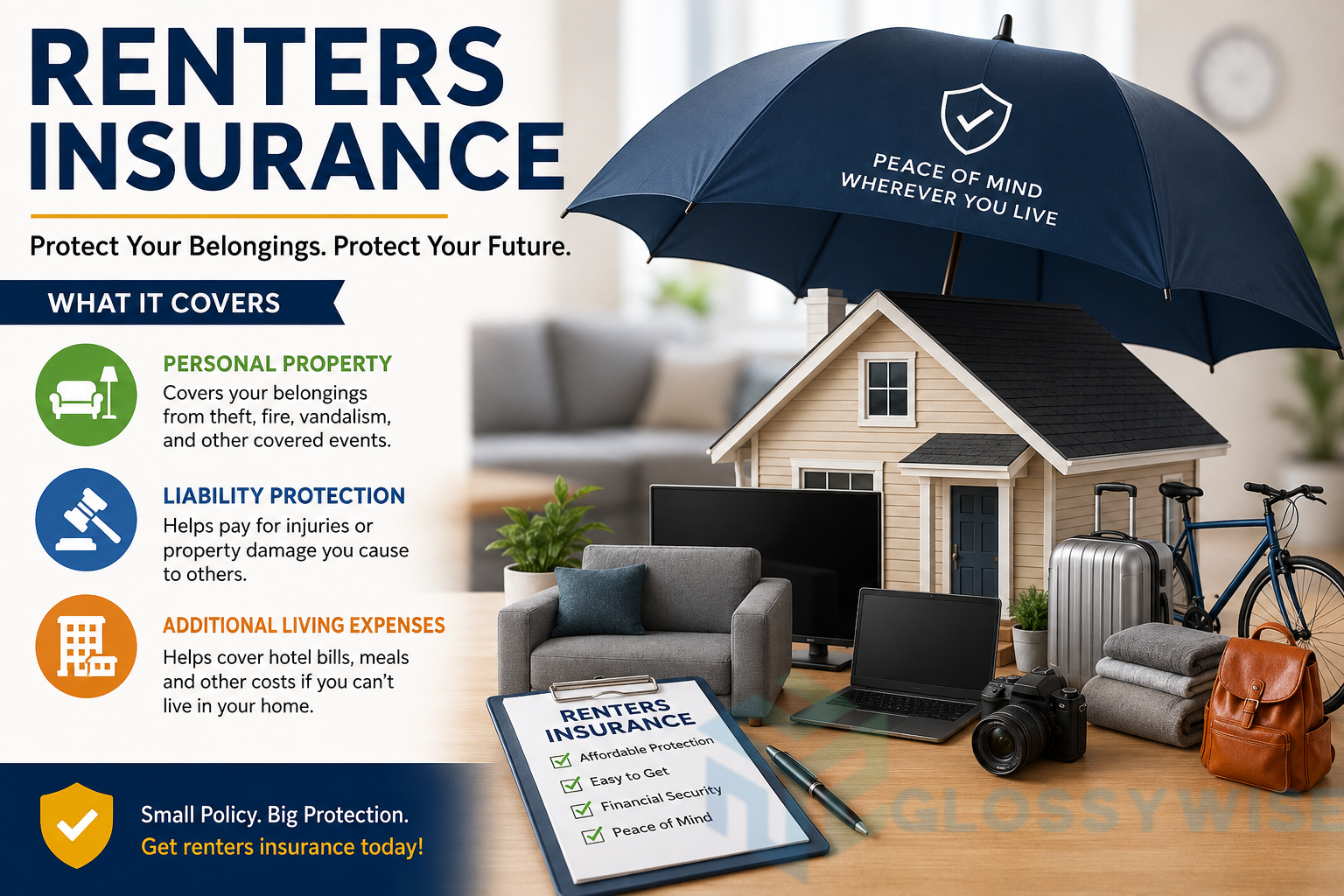
Renting a house or apartment does not mean you have to take the financial risk of losing everything you own. If a fire, theft, vandalism, severe storm, or another covered event damages your belongings, your landlord’s insurance generally does not replace your personal property.
That is where renters insurance comes in.
Renters insurance is designed to protect tenants against certain financial losses involving their personal belongings, personal liability, and additional living expenses. It can be useful whether you rent a small apartment, a house, a studio, or another eligible residential property.
However, renters insurance does not cover every type of loss. Coverage depends on the policy, exclusions, limits, deductibles,e and the cause of the damage.
This complete guide explains what renters insurance covers, what it does not cover, how much it may cost, how to choose a policy, how claims work,ork and what renters should know before buying coverage.
What Is Renters Insurance?
Renters insurance is an insurance policy designed for people who rent their home rather than own the building.
Unlike homeowners insurance, renters insurance generally does not insure the structure of the property because the landlord owns the building. Instead, a renters policy can provide protection for your personal belongings and may also include liability coverage and additional living expenses.
The three major areas of protection are usually personal property coverage, liability coverage, and additional living expenses coverage.
The exact protection varies between insurance companies and policies, so renters should always read the policy terms and exclusions before purchasing coverage.
Why Do Renters Need Insurance?
Many renters assume their landlord’s insurance will protect everything inside their apartment or house. That is usually not the case.
A landlord’s insurance policy is generally designed to protect the building and the landlord’s financial interests. It typically does not replace a tenant’s furniture, clothing, electronics, appliances or other personal belongings.
Imagine losing your television, laptop, furniture, clothes, kitchen equipment and other possessions because of a covered fire. Replacing everything at once could cost thousands of dollars.
Renters insurance can help reduce that financial risk.
It can also provide liability protection if you accidentally injure another person or damage someone else’s property and may help with qualifying additional living expenses if a covered event makes your rental temporarily uninhabitable.
What Does Renters Insurance Cover?
Renters insurance coverage depends on the policy, but common areas of protection include personal belongings, liability and additional living expenses.
Covered causes of loss may include certain incidents such as fire, smoke, theft, vandalism, lightning, explosion and certain types of storm or water damage.
However, not every disaster is automatically covered.
Always check your policy to understand exactly which causes of loss are included and which are excluded.
Personal Property Coverage
Personal property coverage protects eligible belongings you own or have in your possession against covered causes of loss.
Depending on the policy, covered property may include furniture, clothing, televisions, computers, kitchen equipment, appliances, bedding and other household belongings.
Common covered events may include fire, smoke, theft, vandalism, certain types of water damage, wind-related damage and other listed causes of loss.
The amount of coverage you need depends largely on the value of your belongings. Creating a home inventory can help you estimate how much personal property coverage you need.
Does Renters Insurance Cover Theft?
Many renters insurance policies cover theft of eligible personal belongings, subject to the policy’s terms, limits and deductible.
For example, if someone breaks into your apartment and steals covered electronics, clothing or furniture, you may be able to file a claim.
Some policies also provide off-premises coverage, meaning certain belongings may remain covered when they are temporarily outside your rental home.
However, expensive jewelry, collectibles and other high-value possessions may have special limits. If you own expensive items, ask your insurer whether additional coverage or a scheduled endorsement is appropriate.
Does Renters Insurance Cover Fire?
Fire is commonly included among the covered causes of loss under renters insurance policies.
If a covered fire damages your belongings, the policy may help pay for eligible losses up to your coverage limits after the applicable deductible.
If the rental property becomes temporarily uninhabitable because of a covered fire, additional living expenses coverage may also help pay qualifying costs.
The building itself is generally the landlord’s responsibility rather than the tenant’s renters insurance policy.
Does Renters Insurance Cover Water Damage?
Renters insurance can cover certain types of water damage, but the answer depends on the source and cause of the water.
For example, sudden and accidental water damage may be treated differently from gradual leaks, poor maintenance,e or flooding.
Flood damage is generally excluded from a standard renters insurance policy.
Because water-related insurance claims can be complicated, renters should check the policy’s definitions, exclusions, and conditions rather than assuming that every type of water damage is covered.
Does Renters Insurance Cover Natural Disasters?
Natural-disaster coverage depends on the specific event and the policy.
Certain losses caused by fire, lightning, and some storms may be covered. However, flood and earthquake damage are generally excluded from standard renters insurance.
Other risks can also vary depending on where you live.
Renters in areas exposed to hurricanes, wildfires, severe storms, earthquakes,s or flooding should pay particular attention to exclusions and ask whether additional coverage is available.
What Does Renters Insurance Not Cover?
Understanding exclusions is just as important as understanding what a policy covers.
Common exclusions or limitations can include:
- Flood damage
- Earthquake damage
- Normal wear and tear
- Certain maintenance-related problems
- Intentional damage
- Certain business-related losses
- High-value property above special policy limits
- Losses caused by specifically excluded events
The exact exclusions vary between policies.
Never assume that having renters insurance means every type of disaster or loss is covered.
Does Renters Insurance Cover Liability?
Yes. Liability coverage is an important part of many renters insurance policies.
If you or another covered household member accidentally causes bodily injury to another person or damages someone else’s property, liability coverage may help with eligible claims and legal defense costs, subject to the policy’s limits and exclusions.
For example, if a visitor is injured in your rental home or you accidentally damage another person’s property, renters liability coverage may provide financial protection.
Does Renters Insurance Cover Pets?
A renters policy may provide liability protection for certain injuries or property damage caused by a covered pet.
However, coverage is not unlimited.
Breed restrictions, exclusions, state regulations and individual insurer rules can affect whether a particular animal or incident is covered.
If you have a dog or another pet, ask your insurer exactly what liability protection applies before purchasing a policy.
What Is Additional Living Expenses Coverage?
Additional Living Expenses, commonly called ALE, can help when a covered event makes your rental home temporarily unlivable.
Depending on the policy, eligible expenses may include:
- Hotel accommodation
- Temporary rental housing
- Certain additional food expenses
- Temporary living arrangements
- Other qualifying costs caused by displacement
ALE does not usually mean unlimited reimbursement for every expense.
Policies can have financial and time limits, and the insurer may calculate reimbursement based on qualifying additional expenses compared with your normal living costs.
How Much Renters Insurance Do You Need?
The amount of renters insurance you need depends largely on the value of your belongings and the level of liability protection you want.
Start by making a complete inventory of your possessions.
Include furniture, clothing, computers, televisions, appliances, kitchen equipment, sports equipment, jewelry, and other valuable items.
Do not focus only on expensive possessions. Smaller items can add up to a surprisingly large amount when everything needs to be replaced at once.
How to Make a Home Inventory
A home inventory can make it easier to estimate your coverage needs and document a claim.
Walk through every room and create a list of your possessions.
Take photographs or videos and keep receipts for expensive purchases whenever possible.
For electronics and other valuable items, record serial numbers, model numbers,s and purchase information.
Store your inventory somewhere safe outside the rental property, such as secure cloud storage.
Update the inventory when you purchase expensive items or replace major possessions.
Actual Cash Value vs. Replacement Cost
One of the most important things to understand when buying renters insurance is the difference between Actual Cash Value and Replacement Cost coverage.
What Is Actual Cash Value?
Actual Cash Value, or ACV, generally takes depreciation into account when determining the value of covered property.
For example, an older television may be worth significantly less today than the price of a new television.
Under an ACV policy, depreciation can reduce the amount paid after a covered loss.
What Is Replacement Cost Coverage?
Replacement Cost coverage is designed to pay the cost of replacing covered property with similar property without deducting depreciation, subject to the policy’s terms and limits.
Replacement Cost coverage can therefore provide more protection after a major loss.
However, premiums and policy conditions can vary, so compare both the price and benefits before making a decision.
What Is a Renters Insurance Deductible?
A deductible is the amount you are responsible for paying toward a covered claim before the insurance company pays the remaining eligible amount.
For example, if your covered loss is $5,000 and your deductible is $1,000, the insurer may pay $4,000 if the loss is otherwise fully covered.
A higher deductible can sometimes reduce your premium, while a lower deductible can increase the premium.
Choose a deductible that you could realistically afford if you needed to file a claim.
How Much Does Renters Insurance Cost?
There is no single renters insurance price for everyone.
Your premium can depend on factors such as:
- Location
- Coverage limits
- Deductible
- Claims history
- Property characteristics
- Security features
- Available discounts
- Optional endorsements
- Insurance company pricing
The cheapest policy is not necessarily the best policy.
When comparing renters insurance costs, look at the coverage limits, deductible, exclusions, ns and benefits instead of focusing only on the monthly premium.
How to Get Cheap Renters Insurance
There are several legitimate ways to reduce the cost of renters insurance.
Start by comparing quotes from multiple insurance companies.
Ask about discounts for security systems, smoke detectors, deadbolt locks, and other safety features.
Some insurers also offer discounts when you bundle renters insurance with auto insurance.
You can also consider a higher deductible if you could comfortably afford it after a claim.
However, do not reduce important coverage simply to get the lowest possible price.
The goal should be affordable protection rather than the cheapest policy available.
Does Renters Insurance Cover Roommates?
Do not automatically assume that your roommate is covered by your renters insurance.
Coverage depends on the insurer, policy, and household circumstances.
If you live with a roommate, ask the insurance company exactly who qualifies as an insured person.
In many situations, each roommate may need their own renters insurance policy.
Some insurance companies may allow couples or household members to share a renters policy.
However, simply living together does not necessarily mean another person is automatically covered.
Before purchasing a policy, tell the insurer who lives in the rental property and ask exactly who will be insured.
Renters Insurance in the USA
Renters insurance is widely available across the United States and is commonly offered by major national and regional insurance companies. Coverage and pricing can vary significantly depending on your state, location, deductible, personal property limits, liability coverage, and insurance provider. Some landlords also require tenants to carry renters insurance as part of the lease agreement. When shopping for coverage in the USA, renters should compare more than just the monthly price. Understanding exclusions, coverage limits, replacement cost options, liability protection, and additional living expenses can help you choose a policy that better matches your needs.
Best Renters Insurance
The best renters insurance is not necessarily the policy with the cheapest premium. A good policy should provide enough personal property coverage to replace your belongings after a covered loss while also offering suitable liability protection. Renters should compare deductibles, exclusions, claim handling, additional living expenses, special limits for valuables, and whether personal property is covered using actual cash value or replacement cost. Because everyone’s situation is different, the best renters insurance for one renter may not be the best choice for another.
Renters Insurance Quote
A renters insurance quote is an estimate of how much you may pay for coverage based on information such as your location, property value, coverage limits, deductible, claims history, and selected options. Getting several quotes can help you understand the price range available in your area. When comparing quotes, make sure the policies provide similar coverage because a cheaper quote may have lower limits or a higher deductible. Comparing the details behind the price is more useful than simply choosing the lowest number.
State Farm Renters Insurance
State Farm is one of the well-known insurance companies that offers renters insurance in the United States. Its renters coverage can be considered by people looking to protect personal belongings and obtain liability protection. Availability, coverage options, discounts, and pricing can vary depending on location and individual circumstances. Anyone considering State Farm renters insurance should review the actual policy details and compare the quote with other insurers before making a final decision.
Lemonade Renters Insurance
Lemonade is an insurance company known for offering renters insurance through a digital-first approach. Its online platform allows customers in eligible locations to explore coverage and obtain information about policies without relying entirely on a traditional insurance office. Lemonade may appeal to renters who prefer managing insurance digitally. However, renters should still compare coverage limits, exclusions, deductibles, claims processes, and optional protection with other available policies rather than choosing an insurer based only on convenience.
Progressive Renters Insurance
Progressive is another major insurance brand associated with renters insurance options in the United States. Renters can explore coverage for personal belongings and liability depending on the policy and location. Pricing and availability can vary, and renters may also find opportunities to combine different insurance products depending on their circumstances. Before selecting Progressive renters insurance, compare the coverage limits, deductible, exclusions, and total cost with competing options to determine whether the policy fits your needs.
GEICO Renters Insurance
GEICO is widely recognized for auto insurance, but renters may also encounter renters insurance options through its insurance network and partners. The exact company providing the renters policy can depend on the customer’s location and circumstances. This is important because the policy terms, coverage limits, discounts, and claims process may be determined by the actual insurer underwriting the policy. Anyone searching for GEICO renters insurance should review the policy documents carefully instead of assuming that renters coverage works exactly like GEICO auto insurance.
Assurant Renters Insurance
Assurant is another insurance provider associated with renters insurance, including coverage options used by tenants and, in some cases, property management programs. Its policies may provide protection for personal belongings and liability depending on the selected coverage. Renters should pay close attention to deductibles, exclusions, coverage limits, and any special conditions. If renters insurance is being offered or required through an apartment community, it is also worth checking whether the policy meets the insurance requirements listed in the lease.
Allstate Renters Insurance
Allstate offers renters insurance options designed to help tenants protect personal property and obtain liability coverage. Like other insurers, the price and available coverage can vary according to location, policy limits, deductible, and personal circumstances. Renters considering Allstate should compare its quote with other companies using similar coverage levels. Looking at the full policy rather than only the advertised price can help renters understand what they are actually purchasing.
Renters Insurance on Reddit
Reddit discussions about renters insurance often include questions about cost, claims, coverage limits, roommates, theft, apartment requirements, and whether a policy is worth buying. Community discussions can be useful for understanding real-world questions renters encounter, but individual Reddit experiences should not be treated as official insurance advice. Insurance policies vary by state and company, so information from another renter may not apply to your situation. It is better to use online discussions for general ideas and then confirm important coverage details directly with the insurer or policy documents.
Is Renters Insurance Worth It in the UK?
Whether renters insurance is worth it in the UK depends on what protection a tenant needs. Tenants may consider contents insurance to protect belongings, while additional options can provide protection for certain liabilities or other risks. The terminology and insurance structure in the UK can differ from the United States, so a US-style renters insurance policy should not be assumed to work the same way. Renters should check what their landlord requires and consider the value of their belongings before deciding what level of cover is appropriate.
How Much Is Renters Insurance in Canada?
The cost of renters insurance in Canada varies according to factors such as location, coverage amount, deductible, building characteristics, claims history, and the options selected. Tenants in major cities may receive different quotes from renters in smaller communities because insurance risks and pricing can vary by area. Instead of relying on a single average figure, getting several quotes can provide a more realistic idea of what renters insurance may cost for your particular situation.
How Much Does Renters Insurance Cost?
There is no universal price for renters insurance because insurers calculate premiums using different factors. Your location, amount of personal property coverage, liability limit, deductible, claims history, building characteristics, security features, and optional endorsements can all influence the premium. Comparing multiple quotes is usually the best way to find competitive pricing. However, renters should avoid choosing a policy solely because it has the lowest monthly cost, since cheaper coverage may come with lower limits or fewer protections.
What Does Renters Insurance Cover?
Renters insurance can generally provide three important types of protection: personal property coverage, liability coverage, and additional living expenses. Personal property coverage can help with covered losses involving belongings such as furniture, clothing, electronics, and household items. Liability coverage may help when the renter is legally responsible for certain injuries or property damage involving another person. Additional living expenses may help with qualifying costs if a covered event makes the rental home temporarily unlivable.
Does Renters Insurance Cover Theft?
Many renters insurance policies provide coverage for theft of eligible personal belongings, subject to the policy’s deductible, limits, exclusions, and covered causes of loss. This can potentially apply when belongings are stolen from the rental property and, depending on the policy, may also provide limited off-premises protection. High-value items such as jewelry, collectibles, expensive electronics, and certain equipment can have special limits. Renters should check the policy before assuming that an expensive item is fully covered.
Does Renters Insurance Cover Water Damage?
Renters insurance may cover certain types of sudden and accidental water damage, but coverage depends on the source and circumstances of the loss. A standard policy generally does not provide flood insurance, and gradual leaks, maintenance problems, or excluded causes may be treated differently. For example, water damage caused by a covered event may receive different treatment from damage caused by long-term neglect. Renters should read the water-damage exclusions in their policy rather than assuming every water-related loss is covered.
Does Renters Insurance Cover Fire?
Fire is commonly included among the covered causes of loss in renters insurance policies. If a covered fire damages or destroys eligible personal belongings, the policy may help pay for the loss after applying the deductible and policy limits. If the rental becomes temporarily uninhabitable because of a covered fire, additional living expenses coverage may also help with qualifying costs. The building itself is generally the landlord’s responsibility, while the renter’s policy focuses on the tenant’s belongings and eligible liabilities.
Is Renters Insurance Required?
Renters insurance is not necessarily legally required for every tenant. However, a landlord or property management company may require tenants to maintain a policy as part of the rental agreement. Requirements can also vary depending on location and the terms of the lease. Even when renters insurance is optional, it can provide valuable protection because replacing an entire household after a major loss can be financially difficult. Always check your lease to see whether insurance is required.
Renters Insurance vs. Landlord Insurance
Renters insurance and landlord insurance protect different people and interests. Landlord insurance generally focuses on the rental property’s structure and the owner’s risks, while renters insurance is designed to protect the tenant’s belongings and provide certain liability protection. A landlord’s insurance policy generally will not replace a tenant’s stolen laptop, clothing, furniture, or other personal possessions. This is why renters should not assume that the landlord’s insurance automatically protects everything inside the rental.
Do College Students Need Renters Insurance?
College students may have some protection under a parent’s homeowners or renters insurance policy depending on their living arrangement and the policy terms.
A student living in a dorm may be treated differently from a student renting an apartment away from campus.
Students should contact their parents’ insurer before assuming that all of their belongings are covered.
If coverage is insufficient, a separate renters insurance policy may be worth considering.
Does Renters Insurance Cover a Car?
No. Renters insurance does not replace auto insurance.
Your car, truck,ck or motorcycle generally requires a separate auto insurance policy.
However, a renters policy may cover certain personal belongings stolen from a vehicle, depending on the policy and circumstances.
The vehicle itself and the personal items inside it are treated differently by insurance policies.
Does Renters Insurance Cover Property Away From Home?
Many renters insurance policies include some form of off-premises coverage.
This protects eligible personal belongings while they are temporarily outside your rental home.
For example, certain belongings stolen while traveling may be covered depending on the policy.
However, off-premises coverage can have lower limits and specific conditions.
If you regularly travel with expensive electronics, jewelry or other valuables, check your policy before relying on this protection.
Are Jewelry and Other Valuables Covered?
Jewelry, collectibles, expensive electronics, musical instruments, ts and other valuables may have special limits under a standard renters policy.
If your valuable possessions are worth more than the policy’s special limits, you may want to consider additional scheduled personal property coverage or another suitable endorsement.
Keep receipts, photographs, and appraisals for expensive items whenever possible.
Does Renters Insurance Cover a Bicycle?
A bicycle can generally qualify as personal property under a renters insurance policy, subject to the policy’s terms and limits.
Expensive bicycles and specialized sports equipment may require additional coverage depending on their value.
Keep photographs, receipts, and identifying information for expensive bicycles in case you need to prove ownership or value after a covered loss.
Does Renters Insurance Cover Business Equipment?
Personal renters insurance should not automatically be assumed to provide full coverage for business property or business activities.
If you work from home, freelance, operate a small business, or keep expensive business equipment in your rental property, ask your insurer about the available protection.
Depending on the situation, additional business-related coverage may be necessary.
How to Choose the Best Renters Insurance
Choosing the best renters insurance is about more than finding the lowest price.
Compare:
Coverage Limits
Make sure your personal property limit is high enough to replace your belongings after a major covered loss.
Deductible
Choose a deductible that fits your budget and that you could afford after an unexpected event.
Coverage Type
Compare Actual Cash Value and Replacement Cost coverage carefully.
Liability Limit
Make sure the liability limit provides an appropriate level of protection for your circumstances.
Additional Living Expenses
Understand how much ALE coverage is available and how long it can apply.
Exclusions
Pay close attention to what the policy does not cover.
Special Limits
Check special limits for jewelry, electronics, bicycles, collectibles, es and other valuable possessions.
Claims Service
Consider the insurer’s reputation for handling claims rather than choosing a company based only on price.
How to Compare Renters Insurance Quotes
Getting several renters insurance quotes can help you find competitive pricing.
Try to compare similar coverage from each insurer.
If one policy has a lower premium but also has lower coverage limits or a higher deductible, it may only appear cheaper because it provides less protection.
When comparing quotes, keep the coverage limits and deductible as similar as possible.
Also ask about discounts, optional endorsements, and additional fees.
What Documents Should You Keep?
Keep your insurance documents and personal-property records in a secure location.
Important records can include:
- Insurance policy
- Declarations page
- Home inventory
- Receipts
- Photographs
- Videos
- Serial numbers
- Appraisals
- Claim correspondence
Digital copies can be particularly useful if your rental property becomes inaccessible after a major loss.
How to File a Renters Insurance Claim
If a covered event causes damage or loss, contact your insurance company as soon as reasonably possible.
The exact claims process depends on the insurer and policy, but several steps can make the process easier.
Report Theft or Vandalism
If your property was stolen or vandalized, contact the appropriate law-enforcement agency and obtain a report when applicable.
Contact Your Insurance Company
Tell the insurer what happened and ask what documents and information are required.
Ask about the claim deadline, deductible, coverage limits, and next steps.
Document the Damage
Take photographs and videos of the damaged property.
Do not throw away damaged items before speaking with your insurer or claims adjuster unless keeping them creates a health or safety risk.
Prepare a List of Lost Items
Create a detailed list of damaged or stolen belongings.
Include purchase dates, estimated values, receipts,s and other supporting evidence when available.
Keep Receipts for Temporary Expenses
If you need to relocate after a covered event, keep receipts for qualifying additional living expenses.
These records can help when requesting reimbursement under ALE coverage.
What Happens After You File a Claim?
An insurance company may assign a claims adjuster to investigate the loss.
The adjuster may review the circumstances, inspect the damage,ge and examine documents supporting your claim.
The final payment can depend on coverage limits, deductible, exclusions, valuation method, and evidence supporting the loss.
If you disagree with a claim decision, ask the insurer to explain the decision and review the relevant policy language.
If the problem remains unresolved, you may consider contacting your state’s insurance regulator or an appropriate consumer-protection agency.
Renters Insurance vs. Landlord Insurance
Renters insurance and landlord insurance serve different purposes.
| Feature | Renters Insurance | Landlord Insurance |
|---|---|---|
| Tenant’s personal belongings | Usually covered | Generally not covered |
| Building structure | Generally not covered | Generally covered |
| Tenant liability | Usually included | May cover landlord-related liability |
| Additional living expenses | May be included | Depends on landlord policy |
| Tenant furniture | Usually covered | Generally not covered |
| Rental building | No | Yes |
The key difference is simple: the landlord’s insurance generally protects the building, while renters insurance is designed to protect the tenant’s belongings and certain personal liabilities.
Is Renters Insurance Required?
Renters insurance is not necessarily required by law everywhere.
Requirements can depend on your state, localrules,, and rental agreement.
Some landlords require tenants to maintain renters insurance as a condition of the lease.
Even when it is not legally required, renters insurance can still provide useful financial protection.
Check your lease and local requirements to determine whether coverage is required in your situation.
Is Renters Insurance Worth It?
For many renters, renters insurance can be worth considering because replacing an entire household after a major covered loss can be extremely expensive.
Furniture, clothing, electronics, appliances,s and personal belongings can quickly add up.
Renters insurance can also provide liability protection and may help with qualifying additional living expenses after a covered event.
Whether a policy is right for you depends on your belongings, financial situation, risk exposure, and available coverage.
When Should You Buy Renters Insurance?
The best time to buy renters insurance is before you need it.
Ideally, arrange coverage before moving into your rental home or as soon as possible after signing your lease.
Do not wait until after a theft, fire, or other loss.
Insurance is designed to protect against eligible future risks, not losses that have already occurred.
What Should You Ask an Insurance Company?
Before buying renters insurance, ask questions such as:
- What exactly does this policy cover?
- What are the major exclusions?
- Is personal property covered at replacement cost or actual cash value?
- What is the deductible?
- What is the liability limit?
- How much additional living expenses coverage is included?
- Are jewelry and electronics subject to special limits?
- Is flood damage covered?
- Is earthquake damage covered?
- Are roommates covered?
- Are my belongings covered while traveling?
- What discounts are available?
- Do I need any additional endorsements?
Getting clear answers before purchasing can help prevent unpleasant surprises after a claim.
Frequently Asked Questions About Renters Insurance
What is renters insurance and how does it work?
Renters insurance is designed to protect a tenant’s personal property and provide liability protection. Depending on the policy, it may also help with qualifying additional living expenses when a covered event makes the rental home temporarily uninhabitable.
Is renters insurance mandatory?
Not necessarily. Requirements vary by location and lease agreement. A landlord may require renters insurance even when state law does not generally mandate it.
How much renters insurance should I get?
Your personal-property coverage limit should be high enough to replace your covered belongings after a major loss. A detailed home inventory can help you estimate how much coverage you need.
Does renters insurance cover theft?
Many renters insurance policies cover theft of eligible personal belongings, subject to the deductible, policy limits, and exclusions.
Does renters insurance cover flooding?
Standard renters insurance generally does not cover flood damage. Separate flood coverage may be available depending on your location and insurance options.
Does renters insurance cover earthquakes?
Earthquake damage is generally excluded from standard renters insurance. Separate earthquake coverage or an endorsement may be available in some circumstances.
Does renters insurance cover fire?
Fire is commonly a covered cause of loss, but exact protection depends on the policy. Personal belongings and qualifying additional living expenses may be covered when policy conditions are satisfied.
Does renters insurance cover a roommate?
Not automatically in every situation. Roommate coverage depends on the insurer, policy, and household circumstances. Each roommate should confirm exactly who is insured.
Does renters insurance cover a hotel after a fire?
It may. Additional living expenses coverage can help pay qualifying temporary accommodation costs when a covered event makes the rental home uninhabitable, subject to policy limits and conditions.
Does renters insurance cover belongings outside the home?
Many policies include some off-premises coverage, but limits and covered causes of loss can apply.
Does renters insurance cover my car?
No. Your vehicle generally requires separate auto insurance. Renters insurance may provide coverage for certain personal belongings stolen from a vehicle, depending on the policy.
What is the difference between ACV and replacement cost?
Actual Cash Value generally considers depreciation when valuing covered property. Replacement Cost coverage is designed to pay the cost of replacing covered property without deducting depreciation, subject to policy terms and limits.
Can renters insurance cover expensive jewelry?
It may provide some coverage, but jewelry and other valuables can have special limits. Additional scheduled coverage may be appropriate for high-value items.
Can I get renters insurance if I live in an apartment?
Yes. Renters insurance is designed for people renting apartments, houses,s and other eligible residential properties.
Can college students get renters insurance?
Yes. However, students should first check whether they already have coverage under a parent’s policy. Coverage can vary depending on the student’s living arrangement and policy terms.
Does renters insurance cover pet damage?
Some liability protection may apply to damage or injuries caused by a covered pet, but exclusions and restrictions can apply. Ask the insurer about your specific animal and circumstances.
Compare multiple insurers, ask about discounts, consider the deductible carefully, and make sure you are not paying for unnecessary coverage.
However, do not reduce important protection simply to obtain the lowest premium.
Final Thoughts on Renters Insurance
Renters insurance is more than protection for furniture and electronics. A well-chosen policy can provide three important forms of protection: personal property coverage, liability protection, and additional living expenses coverage. The most important thing is not simply finding the cheapest renters insurance policy. Instead, compare coverage limits, deductibles, exclusions, valuation methods and special limits before making a decision. Creating a home inventory can help you determine how much personal property coverage you need. You should also understand whether your belongings are covered at Actual Cash Value or Replacement Cost. Pay particular attention to exclusions such as floods and earthquakes because standard renters insurance generally does not cover these risks. Most importantly, remember that your landlord’s insurance generally protects the building, not everything you own inside it.
For renters, the right insurance policy can provide an important layer of financial protection against unexpected losses, liability claims, and temporary displacement after a covered event.
